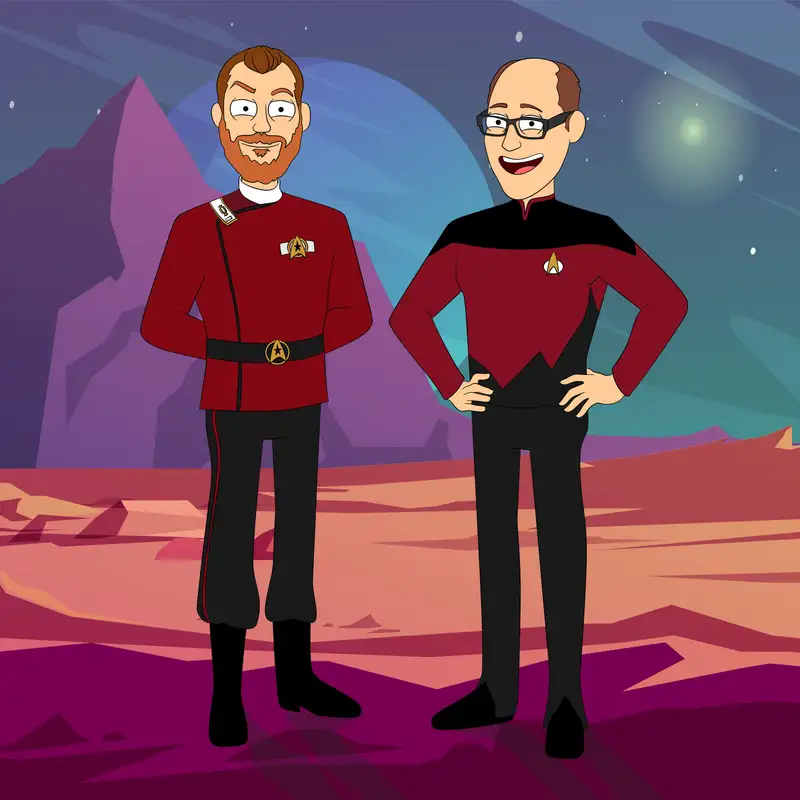
Episode 91: Mothers (SA 1×10 Rubincon)
Kevin: Hello, and welcome back,
one last time for this season of
Starfleet Academy, to Subspace Radio.
It's me, Kevin,
Rob: and me, Rob.
Kevin: And we're here to talk about
season one, episode 10, Rubincon.
Rubincon.
Rob: Rubincon, not Rubicon, Rubin.
Kevin: It was fun watching the
internet puzzle over the spelling
of this episode title in the
hours before the show went live.
About half the sites I visited had
had fixed the typo to Rubicon going,
surely it's Rubicon and everyone who
is before me in the editorial process
before this made it to my desk, got it
wrong, so I'm gonna be the one to fix it.
And then, uh, sure enough, the
actual title is a deliberate typo.
So it was fun, fun to watch
the internet wrestle over the
title of a Star Trek episode.
Rob: We are in indeed in the age
of the internet where subtlety
is, uh, no longer a factor.
Kevin: Yeah, well, at least
Paramount Plus got it right.
They have, they have suffered from
misspellings of their Star Trek
in the past and they got this one.
Right.
So that was good to see.
Rob: That's right, that's right.
Well, yeah, we all remember the
infamous, uh, Deep Space 20, uh, typo.
No, no, no.
That's just,
Kevin: Let's, uh, before we get to our big
topic for this week, which is mothers, uh,
Rob: Yeah.
Kevin: the amazing appearance of Tatiana
Maslany as Caleb's mother, um, let's
talk about this, this season finale, Rob.
It was like a movie length thing.
It was an hour and 15.
Rob: It was longer than I expected.
I, I got home, uh, from work
and sat down and go, well, this
would be done in 45 minutes.
And I was surprised.
I, I got, I got the feeling when they
didn't do the usual opening credits,
they did a title card, a moving
title card over the action, the CGI
Kevin: Gosh, yeah, it was that long
even without an opening credit sequence.
Rob: Yeah, yeah, yeah.
So, um, uh, it was, uh, a bit longer.
It could let some scenes breathe a bit
more, and a great way to finish off
the season to give a bit more, uh, a
breath to everything that is going on.
Kevin: Mm. Yes.
I don't mind saying, I think
they stuck the landing.
This is, uh, this is a solid
end to the season in my books.
Rob: I do too.
I mean, there's a couple of little
gripes about the threat and how it
went to sort of like, uh, you know,
galactic slash universal type, uh,
threat, which in many ways kind of feels
outta character for, uh, uh, Nus Braka.
It could have, it could have
been quite small, just like
surrounding Beta Z or something like
Kevin: Yeah, exactly.
Rob: that's like, that's
type of nitpicky stuff.
Um, the, the, the, the, the, you know,
the thrust of it was, it was a really
good episode of, of, of Star Trek.
Wonderful writing, really good effects,
really raises up the character stakes.
Incredible scenes where we had not
one, not two, but three Emmy award
winning actors, um, you know, one
Academy Award winner, one academy
nominee, um, all in the same scene.
And, and to quote Dr. Who, uh, everybody
lives like, pretty much everyone
survived this, which was remarkable.
Kevin: Mm. Yeah.
I, I was at, at a certain point
I sort of like stepped out of the
episode while I was watching and went,
this is people arguing over issues.
Like, this is the final battle of this
season is a battle of words and ideas.
And isn't there anything
more Star Trek than that?
Rob: Even though we've only had Tatiana
for two episodes, really, we had a
little bit of episode one to cover
that gravity, that emotional weight,
Kevin: She had a tough job to build
up, I feel like a head of steam and
gravitas quickly because they didn't,
there wasn't a lot of room for her
in these last couple of episodes.
So she had to, she had to get
there fast and, and play a lot of
depth of emotion with a very few
seconds of, of footage, I felt.
Rob: Definitely.
And we've seen it all from sort like
Caleb's point of view, and he had an
entire season to work through that trauma.
Um, whereas Anisha had, to do it in,
um, yeah, like you said, minutes,
sometimes seconds of, uh, of screen time.
Kevin: I felt like she had, she spent a
lot of this episode in kind of wide-eyed
shock at what, what was happening to
her and the feelings it was bringing up
the, i i, she was hired for the wideness
of her eyes at times it felt like.
But um, those, those final moments of her
taking the floor in the trial and holding
the Federation through Ake to account,
uh, was powerful and great to watch.
Her reaction to the reason
from Ake of just like stony
face going Nala Ake is guilty.
Uh, I, I really enjoyed that moment
of like, she knows she's wrong,
but she's choosing to double down
on the wrongness in this moment.
Rob: Yeah, there was a beautiful moment
of the counter argument, which hasn't
been really raised because it's been
focusing on, you know, Caleb and Anisha.
Just the moment of going,
okay, we're focusing on loss.
Let's focus on the man that was killed.
Kevin: Mm.
Rob: What did you expect to happen with
the situation that you were going into?
This man was, this man's life was
taken, and she and Ake making it
clear that this does not take away
the pain and the torture that you
went through, but you, you are not
an innocent party in this situation,
which I found really quite powerful.
It was done in a nice way
that it wasn't, um, jarring.
It wasn't, um, uh, emotionally
or morally awkward.
It was a really nice, well made
point to give a bit of scope and,
uh, perspective on the situation,
which I, um, really appreciated.
It was really clever and
really emotionally mature.
Kevin: And I really liked that Nus
Braka kind of had a point as well.
Like you could see it from his
perspective and go, well, yeah,
you know, his actions are kind of
justified from his point of view.
Uh, it feels like a while since we've
had a Star Trek villain who wasn't
A) a madman, or B) just a friend
who doesn't understand you yet.
you know, I'm thinking like the, the, the
species 10-C in, in Discovery where it was
at the end of the day, it was like, if we
can just manage to get to them and talk to
them, this can all be all be sorted out.
And, uh, no, like no Nus Braka has,
you know, he has a life experience.
He, he understood the truth of the
situation to be different than it was.
Uh, and acted one might say accordingly.
The, uh, the Omega 47 stuff, I think
is an interesting shade of gray that
if you go back, I've seen some, uh,
some YouTube videos breaking this down,
that if you go back and and hear, uh,
Admiral Vance talking about the theft of
the Omega 47 in the earlier episode, he
says it was a weapons research station.
He says, that was not the only
weapon we were developing there.
And so for Nala on the stand to say we
weren't developing it as a weapon, we were
developing it as a power source, I don't
know if the intent that was the intended
truth in that moment, but the writers,
if it was, the writers didn't quite get
their stories straight in these episodes.
And I think I choose to believe that
the, the, the truth is a little grayer
there, that they were researching it as
a power source and a weapon if need be.
And, uh, some, it was on some people's
budgets as a weapons research program,
and that Nala flexed the truth when
put on the stand and that even the
Federation is not completely perfect.
Rob: Yes.
And anytime I heard, uh, Omega 47,
I just immediately go to Galaxy
Quest and go, ooh, Omega 13.
Kevin: 47 is a, uh, is a
joke number in Star Trek.
There's a long history, uh, starting
with Star Trek writer Joe Mansky,
who went to a college where there
was a club called the 47 Society.
Bringing it to Star Trek, he decided
to use that number whenever he
could as a nod to his alma mater.
And it survives to this day.
Every time they need a
conspicuous number, it's 47.
Rob: Well, there you go.
I found, um, I found Giamatti
was at his best here.
There was like, there was an element
of menace and intensity and maybe a
little bit of, um, scenery chewing
with his previous appearances.
But this one was, there was a nice balance
of showing that vulnerability as well,
and that his truth about his father.
And he genuinely was shocked to find
out the truth of the matter from AKIs
point of view, which he didn't believe.
But
Kevin: Lies and propaganda!
No, it's science.
Rob: Uh, I would go so
far as to say fake news.
Kevin: He's great.
He was off the leash.
There are some moments where like
he was physically grandstanding in a
way that was very enjoyable to watch.
In a script that could have been a
talking head, he was a stalking tiger
around that, that big atrium set.
It was fun, fun to watch, for
Rob: And, and, having that balance of,
well, the atrium set being, you know,
made to look like it's been destroyed,
you know, classic Star Trek element there.
But, um, he, his balance of his
menace, his, his, his panther stalking,
but also his showmanship appeal to
the masses of everyone watching.
There was a great balance.
So he couldn't be like in
that previous episode with
Ake, where he was just menace.
There was no one watching him, so
he could be pure, I just hate you.
But this is, he's had that balance
of menace and intimidation, but
also that showing off to the people.
Yeah.
Kevin: Frankly, genius
set reuse, I have to say.
That that atrium set, uh, was used in so
many ways this season, and you, you can,
when you look back, you're like, this is
why the Athena did the saucer separation.
This is why the ship
was designed that way.
You could tell that early in the
conception of this or production
of this show, they were saying, we
can't afford to build the atrium.
And they said, well, what if we, what
if we also use it as a debate stage for
the site of the federation headquarters?
They're like, well, that'll
save you a few thousand dollars,
but we still can't afford it.
What if it's also a phaser tag court?
What if it's also the
ship's theater stage?
And what if it's also the big
bad's layer outside of Federation
space on at the end of the season?
And they went, okay,
you can have the money.
Rob: Yeah.
Kevin: So much of not just this
episode, but this entire season was
structured around, it felt, that
constraint of we want to build this
yawning space that feels like a campus
ground, but we can only afford it
if we find another way to use it.
Another set.
We would not have to build every single
episode this season, it felt like.
Rob: Yes.
Kevin: Yeah.
Rob: So that's, that was
kind of our B story, really.
Or was it the a it's the, A story, but the
B story is kind of our lead characters.
So while this is all going on, we've
got, uh, the saucer section, uh,
still in trouble, and our cadets are
there being led by, uh, not Captain
Kevin: not Captain,
Rob: Commander Jett Reno.
Kevin: Jett Reno in teacher
mode is my favorite thing.
Rob: Oh, Tig, Tig, Tig Notaro has
been going up and up and up and up,
and this episode, she slayed it.
She absolutely slayed it.
She was absolutely amazing.
Incredible, beautiful, beautiful words
for her to sprout out and yeah, teaching
teacher commander and get out of this
situation and engineering as well.
Let's solve the problem.
Kevin: Yes.
It's, it's a new angle on a bridge
scene is to turn it into a classroom.
And it worked so well.
When she, when she, you know, slipped
out of, okay, I need to be hands on
because this is a crisis to, it's
still a crisis, but we've got the time.
So I'm gonna start teaching again.
I'm gonna start asking questions.
What do you think?
You tell me.
This is your final exam.
Either you pass and everyone goes
home, or you fail and we all die.
You know, all of that stuff
was just so delightful.
Rob: It was the perfect bookend to what
we got in the first episode where the,
you know, where we were introduced to
this crew that we've never seen again,
but, um, they were thrown into the thrust
of the situation even before they had
started their, their training and now
to have the end of the season, they're
in a similar situation but at higher
stakes and they are now fulfilling
the roles, and kind of shaping where
they will go in what branch of the
Federation they will go into in Starfleet.
Kevin: Yeah.
Uh, I liked watching her manage Caleb,
like she was kind of taking stock
of Okay, you know, I've got Genesis.
She's probably reliable enough
to put in the command chair,
even if she does have to pee.
I've got, uh, I've got Darem, who,
as long as we can get him to stop
speeding, he, he can run the ship
and, and Caleb is the most volatile.
He's the one, like second
guessing everything.
So when she has to go and fix the
Warp core, she says, you're with me.
And you can see her going, you're the
one I can't leave alone on this bridge.
So you're coming with me and I'm gonna
trust the rest of these cadets to, to
not burn the place down while I'm gone.
Yeah.
Just so good.
Rob: And grateful, great moment that
we come back to, uh, really rewarded.
So with their first interaction together,
you know, Jett asks him, who are you?
And he goes, now that's your name.
Who are you?
Really?
I don't know who you are.
And to go finally with him talking
about why he didn't abandon his friends,
Kevin: Such a delight that they had
the time to do those, like plant
those seeds earlier in the season
to pay off here in the finale.
It feels like so many other Star
Trek seasons recently have been a mad
dash to the finish line, so that they
were writing the last episodes after
the, the first episodes were filmed.
And so they didn't have that luxury to,
to do those, those plants and payoffs.
But uh, they did it here.
It was awesome.
I heard, um, in an interview, Alex
Kurtzman was saying that this final
episode was one that, uh, when, when
they were coming up to it, they decided
it wasn't working as well on the page
as they quite liked, and they, they
kind of pulled the episode apart and did
surgery on it and changed the structure.
The, the main beats, the actual
story stayed the same, but they
restructured the episode in a big way.
And I, I, I don't know what
the before looks like, but
the after looked great to me.
Rob: Very much so, very much so.
Whatever they did, they
did excellent work.
It's one of the best season
finales I've seen in a, in a TV
show in, in a, in a long time,
especially in the Star Trek world.
Um, and in genre based television.
Um, there's been a expectation of how
a season finale is shaped and what
is expected and how you're meant to,
you know, finish off your, your arc.
And especially with a reduced amount
of episodes in a season, it becomes
more about what can you cram in there.
But this was a coherent, um,
conclusion, which I found really good.
Everything was given enough time.
The pace was still really strong,
and all those things that tied in
from previous episodes came back.
It was a nice clarification with SAM
and Genesis really rushed tension,
um, to find that time to clarify it.
It didn't excuse the fact it was
probably rushed a, a, a a lot, but it
was, they took the time in that moment
to, to balance it out, which I loved.
Kevin: Going back to the bridge,
this episode, I don't know if it's
been present in previous ones, but I
noticed it for the first time in this
episode, the Athena Bridge is a step
up from bridges we've seen even through
Discovery and Strange New Worlds.
The four walls, the back front
and sides are all giant screens.
They're actually matrices
of big, uh, LED panels.
So when they, there were several moments
in this episode where they were right near
the screen doing work, and you could see
a conspicuous like vertical black line
and horizontal black line dividing it
into multiple screens, which I guess is,
I think I remarked on that in a Strange
New Worlds episode recently as well, the
big screen that they have at the back
of the conference room in Strange New
Worlds is likewise, it's too big for one
screen, and so they've had to like knit
it together with two screens, and the
seam between them is a visible black line.
So that's a shame that that's there.
But I guess, you know, it's,
it's 21st century practicality.
But um, the fact that those
four walls are big screens,
when the ship was taking a hit.
And the wall, the entire
wall glitched out.
That is something I realized we've
never really seen before in, we're
used to seeing consoles explode and
sparks flying, but the actual graphics
on the screen glitching out and
responding when the ship is taking
damage feels like a new element to me.
And it feels, it works so well.
It feels so obvious.
They all, you know, the cast all throws
themselves sideways and at the same
moment, the screens in the background
static out and it, it looked so great.
Um, and, and felt, felt like
a, a new height to the, um, to
the battle on the bridge sort
of scenario that we hadn't seen
Rob: Agreed.
Agreed, definitely.
Kevin: Uh, what did you think
of, um, of the Doctor faking the
destruction of the Athena saucer?
Rob: Yeah, a little bit, sciencey,
gobbeldy-gookey, but, uh, inspired idea of
incorporating him into the ship's computer
using his old, seeing his old, uh,
Kevin: Yeah, the old mobile emitter, that
he keeps in his inside pocket, apparently.
It's unclear whether he is projecting
himself from it at all times still, or if
he's keeping it for sentimental reasons.
And if the latter, I'm not sure
why he needed to hand it over
in order to make this plot work.
So I gather he is still projecting
himself from this mobile
emitter after all these years.
Rob: Yeah.
Um, and then of course the effects of that
caused him to speak absolute gibberish.
But I thought it was a, a clever idea
when you're in that situation that the
only way to to hide is to use an illusion.
Kevin: They called it
training mission Hermes 19.
And I like the, I like the idea that
the ship has these training missions
and training scenarios built into it.
That is a clever, delightful idea, but
it never quite worked, this season.
They've done it a few different times of
we're gonna, we're gonna activate training
mission X, and it's never been quite clear
in a, in an actual teaching scenario, what
is the function of this training mission?
This training mission apparently
is the Doctor hands over his
mobile emitter and fakes the
explosion of the ship you are on.
I don't, I don't know how that could
be a training mission normally.
Rob: It is very specific.
I mean, it was a little bit
Kobayashi Maru, so maybe the
Doctor's run that program and
this is what he's come up with.
But yeah,
Kevin: Yeah.
Uh, it fun anyway.
And the fact that it was, you know,
used as the title card, that, that
moment of like Starfleet Academy
as we're pushing in on the debris
and then through the debris to the
survived, um, the, the survived saucer.
It was, um, I guess yes, distracting
enough that at least on first
viewing, it made me go, wow.
On second viewing it made me go, wow, that
doesn't quite make sense, but that's okay.
Rob: Yeah, it is that element excused
in, um, modern Doctor Who written
by the great, uh, Stephen Moffat.
Sometimes you have a justification
said really, really quickly and
really convincingly and you believe it
Kevin: It'll get by once.
Yeah.
Rob: Yeah.
And then it's sort of like the
morning after you wake up going,
what, what, what was I doing?
Why did I, why did I believe all
Kevin: That's definitely an element
of modern, modern sci-fi is like,
if the audience is, is second
guessing your explanations, you,
you probably don't have them.
So, uh, Yeah.
There, there's probably another problem.
It's not that your explanation
isn't good enough, it's that
the audience is, is wondering.
Hmm.
The, the Doctor came out of the thing
immediately glitching with the rubin
and the glue and uh, like that's another
one that on second viewing, he, he came
out of the computer immediately talking
about rubin and glue, which to me is, I
guess him attempting to explain the plan
to stabilize the Omega 47 molecules.
So, um, the, it, it's, it's like
that's something that he came
up with inside the computer.
Earlier in the, in that segment,
Vance and Thok were on the comm.
They were talking from the Federation.
They said they would transmit all of the
information about the Omega 47, including
the top secret stuff to the Athena,
and that was never dealt with again.
So I guess what is there to be made
sense of, at least for me, is that
that data went into the computer where
the Doctor was at the time, and he had
a look at it while he was in there.
And that's why he came out immediately
talking about Rubin particles and gluons.
Rob: Look you, you justify
it better than they do.
Kevin: Uh, I, uh, I also liked that
Nus Braka seems throughout the season,
and especially here to be conspicuously
fluent in human or Earth history.
The, the wall at the back of the atrium,
one of the big pieces of graffiti they've
put there is Veni, vidi, vici, Venari.
So, you know, the, they, saw conquered,
uh, um, saying from Earth history.
And he talks about, he says, oh, uh, yeah,
to, to Caleb's mother, he says, you're
like Lazarus except small and a girl.
And so this reference to a biblical
figure, it it, these things, the
tic-tac toe of it, of it, all the,
these elements of like, for one reason
or another, either Braka himself, or
his family or his planet was really
fluent in human history and culture.
And I wonder what that says about the
galaxy in Star Trek, or I wonder what
it says about Nus himself, that was he
obsessed with the Federation, what I took
from him and started to learn these things
about it, that he then incorporates it
in, into his, his madness, if you will.
But, uh, yeah, interesting stuff that
he is, he is definitely not human.
He's famously half
Klingon, half Tellarite.
And uh, and yet he communicates so many
of his ideas through human history.
Rob: Most definitely.
Yeah.
Um, I mean, that could be broken down
as like a lot of justification needed
to be done that, uh, a reference like
that, so specific to Earth can be done,
but get yourself caught up in the,
the beauty and the moment of it all.
Kevin: Yeah.
I, don't it's unexplainable.
I think it, it, it, it offers
up something unexplained for
the audience to find meaning in.
And I think you you could either see
it as part of Nus Braka's story, a
personal story or part of a Galaxy
story, that the human culture has gone
to the stars in such a big way that
even aliens are familiar with these
figures from Earth history and mythology.
Rob: Definitely, definitely.
Kevin: Caleb and Tarima made up on the
bridge with with their, yellow flowers.
How did that work for you?
Rob: Um, it, it, it was good.
Caleb has really grown on me and this
episode in particular, having him so
vulnerable and I like the fact that
he's, yeah, no one should really be
categorized, you know, pigeonholed or
categorized into a cer a certain hole.
But because Caleb has kind
of been, he knows everything.
If there's any problem, he
goes, I got this, I got this.
To get to that point in this episode,
it was actually justifiable to
go, Genesis is going, you know,
leadership, you know, Reymi is going.
Pilot, you've got, uh, Jay-Den
going, um, medicine and going Caleb,
engineering, I went, this is good.
Okay.
Kevin: Yeah.
They're, they're starting to
Rob: the,
Kevin: little crew.
Yeah.
Rob: they're form forming a
crew and he's finding his place.
'cause he's, you know, purposely
hasn't defined where he wants to
go into, but that makes sense.
That's like Scotty, like Geordi, all that.
Solving problems.
Finding problems and solutions and
fixing them, uh, worked for me.
And, um, I think the stuff with him
and Tarima was nicely sorted out.
It was a nice moment at the
end where they, you know, work
through their, their broody issues
'cause they're such children.
Um, but to have that final shot at
the end of them, like hanging out as
a as, as a, as a group of friends, uh,
was a nice satisfactory justification
for that relationship that's had
more time than most relationships.
Uh, especially in the middle.
Most in the middle,
they've lost a lot of time.
So to make up for that, um, and to find
that justification for me was quite good.
And she found her strength,
Tarima, which I really appreciated.
It wasn't that case of I'm too powerful,
just a case of no, I'm, I'm, me and
I, I've got this skill, this ability,
and I need to be able to control it,
like all of us have and abilities.
Kevin: The, um, using her powers to, to
find Caleb's mother was a reminiscent
of the, the Star Trek Nemesis moment
where Troi's is, is using, like she's
holding, I think it's Worf's hands
over the targeting console while
she finds the, the, uh, cloaked,
um, ship of the baddies in that one.
Yeah.
That not the first time, Betazoids
have been able to pin down coordinates
with their, with their abilities.
Rob: Their abilities are limitedly defined
enough so they things like that, that
double doesn't come across as pure magic.
Kevin: Yeah.
Enjoyed the, uh, the Star there,
there is no Starfleet anthem, but
what a good suggestion, was fun.
And the fact that, um, Federation weapons
are famously good guy colors of blue
and green, rather than red, being made
a plot point was delightful as well.
Rob: That was, yeah, really, really good.
That was like the justification of it
from a science point of view of what,
what gas is emitted, oh it's red.
Okay, cool, cool, cool.
And what do we use?
We've never used red.
It was a mix of, you know, scientific
justification and then, you know, logic
and canon of, you know, Star Trek lore.
Um, yeah.
Satisfying ending, and then a lovely
little knot at the end with, uh, as
the cast list uh, rolled, uh, having
photos, uh, of them all as, uh, as be is
Kevin: Yeah, class of 3096, I think it
said, which is that that's not quite
how a graduating class works, that you
don't get to be a graduating class for
graduating the first year of something.
It was, it was fun to
go along with anyway.
And it definitely worth pausing and
reading those things, though they are,
they're kind of messages from the cast.
It was fun.
Tig's says, why did I, why
was I after the two voices?
Because there's the ship's computer and
there's the Digital Dean, and then there's
Rob: that,
Kevin: Tig Notaro.
Rob: And hers is notoriously the oh, hers.
And, um, Vance's photos were notoriously
the eldest of the, young pictures.
Kevin: Well, anything else you wanna
talk about in this season finale, Rob?
Rob: Well, this is, well for
me, I, I thought it was a great,
it's one of the most solid season
finales of modern Trek, definitely.
Kevin: Yeah, not just a finale.
I felt like the season
overall was remarkably solid.
There was one shaky episode in a 10
episode season, and there were, there
were things I liked in that shaky episode.
Um, so, wow, like amazing
quality, I felt like.
At a time where, I think we were
all going into a new Star Trek
series going, here we go again.
It's another season one.
They're gonna take a while to
find their feet and figure it out.
And do I have time for, uh, you
know, a YA version of Star Trek
that might not be written for me?
I was sucked in despite myself and, and
delighted and surprised at every turn.
Rob: It is definitely been, yeah, for
me, I've, I've enjoyed this experience
and I've enjoyed this ride and it's
definitely up there as one of the stronger
of, uh, the modern Star, Star Trek series
and of some of the even classic stuff.
Um, and it's a shame it's, uh, it's been
so, yeah, but everything at the moment
with pop culture is so dividing just with
connected with everything in society, but
I think there's enough positives there
that I hope it will work its way through.
It just won't get defined by the
review bombing and the negativity.
There's a lot in there
to be positive about.
Kevin: I hope so.
I've, I've, you know, much as we like
to find our critiques in these, in these
podcasts that we do, I've always come
at Star Trek in its modern incarnation
from a, like find the good perspective.
Because I'm a, I'm a Star Trek fan here.
I'm not here to tear it down,
I'm here to find what I enjoy
and revel in that part of it.
But Starfleet Academy is
stronger than any, any Star
Trek series in recent memory.
And, and I feel like you don't
have to go looking for the
good it, it will come for you.
And if you're choosing to plant
your feet and go, this is not good.
I think you are, you
are looking for the bad.
Rob: Agreed.
Agreed.
There's a lot of positive in here and, um,
Kevin: I love this so much.
I these characters.
I can't wait to see them again.
I miss them already.
The hiatus is gonna hurt.
Rob: Yeah, big long Wait, I
don't think we'll get it till
probably early next year.
Just
Kevin: Yeah.
Well, it'll be worth the wait, Rob.
Rob: I think so.
I think so.
And now they, they've got that, you
know, that, uh, freshman season out
of the way, now they can move to
a more sophomore type, uh, level.
I hope I'm using the right terminology.
I'm being very, very,
Kevin: I didn't go to college
in the US either, so don't
look to for me to correct you.
Rob: Yeah.
I'm referring a lot to stuff
that I'm trying to remember
from movies and TV shows.
Uh, but yes, our second season will
definitely mean everything's a lot
more stable now we know the characters
and they can just get on with it.
Kevin: Well this episode was the biggest
outing for our character of Anisha
Mir, the mother of Caleb, and it got
us thinking of other prominent motherly
figures in Star Trek and uh, uh, I had
a busy week, so I picked one to focus on
and have a single episode to talk about.
Rob, what have you got?
Rob: Yeah.
I've got a single episode as well.
I was looking at, you know, characters
more from an, uh, you know, as a, as,
as a mother, as a whole character.
But I did find one episode particular
that quite, uh, crucial for a mother.
'cause there's stuff like, you know,
how does Spock's mother play into this?
Like, with her appearance in
the original series and then the
actress coming back in Voyage Home.
Kevin: Amanda Grayson!
Rob: Yeah.
Got, um, Beverly Crusher and then
how Spock's mum has been treated in
other incarnations, like the Kelvin
Kevin: Beverly Crusher, uh, it has
been pointed out to me this week,
is the only like main cast member
who was a mother in the story.
Rob: Um, we've spent, uh, many
episodes discussing like, uh, Benjamin
Sisko as a father and his role as
a son as well, and a, and, and the
Sisko clan as the three Sisko boys.
Um.
But, uh, yeah, to see how
mothers are perceived.
And there's also Lwaxana, but my,
my most prominent episodes of her
when she's there as her as herself.
So we don't see her
really as a mother figure.
We see her as a confidant with Odo.
Um, uh, there's also Moogie.
I was looking at possibly
a Moogie episode.
Kevin: Lovely.
Rob: I, I love her relationship with,
uh, with Quark and how that evolved over
all her appearances, even though they had
original one actress in the first episode,
and then they changed it to the actress
who we all know and love as Moogie.
Um, but yes, I found a, a
different, uh, episode to rest on.
So how about you?
Kevin: Well, I chose one of
the ones you just listed.
Um, so I will jump in because this is
the Next Generation Season seven episode
seven, Dark Page, which is a Lwaxana Troi
episode that is overlooked and forgotten.
Rob: We have not spoken about
this one, I don't think.
Kevin: No, this is, this is for me
Lwaxana Troi's most motherly episode,
where it goes beyond the, the kind of
playful japes of Troi's and Lwaxana and
Riker and Lwaxana and Picard and Lwaxana.
And they, those have all occurred during
the course of The Next Generation,
but here in early season seven, they
are playing on top of that platform.
The opening log entry by the captain
says, we are here hosting the delegation
of this telepathic race called the Cairn.
They are learning to communicate
verbally as part of their efforts
to join the Federation, and they
are being taught by an old friend.
And then it cuts to Lwaxana Troi's in, uh,
Ten Forward at the reception, making, uh,
making a spectacle of herself as always.
Rob: As we'd expect.
Um, was this her final appearance
in the, in the regular series?
Kevin: I would not be surprised.
Would not be surprised if, well, this
is season seven of TNG, I wonder, did we
see her in Deep Space Nine before this?
Uh, I guess we could leave that
as an exercise to the viewer,
Rob: She definitely did do a season
one episode of, uh, Deep Space Nine.
That's one
Kevin: Oh, well there we go.
That might have been during
season six of TNG then.
Rob: Yeah.
Kevin: This, this one here starts
out Lwaxana as usual, but then
they subvert that as she starts
to show some vulnerability.
She's working with these telepaths who
have never communicated with anyone
outside of their race before, so, and
she talks about the fact that when they
communicate it is just a, a barrage of
images that come at you all at once.
Uh, and that, that that is tiring for her.
And she starts to show signs of headaches
and fatigue, and she stops, like just
in the middle of a conversation with
Troi, she kind of stops and hugs Troi and
says, oh, you're my most precious child.
What would I do if anything
ever happened to you?
And it's just like,
where did that come from?
Rob: Yeah.
Kevin: Pretty soon, um, things go
sideways when one of the children of the
delegation, who is played by, uh, by a,
a tiny Kirsten Dunst in one of, one of,
if not her first on-screen roles, um,
she plays the alien little girl, Hedril.
She slips on a rock in the ship's
arboretum and falls into some water.
And at that moment, um,
Lwaxana Troi goes into a coma.
She passes out on the ground
and cannot be revived.
And then much of the rest of this episode
is Troi and Picard and, and the rest of
the crew trying to piece together what has
happened because the aliens say that they
suspect the reason that Lwaxana is, um,
in peril is because she keeps something,
part of her psyche is dark, it is hidden,
which is something unusual to them.
And they, they go looking, they find, they
dig up her personal logs and find that
seven years of them have been deleted.
And, uh, this was during the time before
Troi was born to just after she was born.
And it comes out that Lwaxana had another
daughter before Troi that, uh, sadly,
uh, died in an accident in the park.
They, the dog got away, she ran after
it fell into the water and drowned.
And the parents did not notice
she was gone because they were
looking after Troi, the new baby.
And, and Lwaxana was racked with guilt
for years and only got passed it by kind
of walling those memories off deleting,
deleting her logs, uh, her journals
of the time, and basically forgetting
that she ever had a first daughter.
And that the, the, the interactions
with the Cairn, this, this race
was, was breaking down that boundary
and, and injuring her psychically.
Um, Troi has to go in, into, this is
another one of those mindscape episodes
where she has to lay on the bed next to
her mother and with the help of the alien
explore her mind and Troi gets to meet
her father inside, uh, Lwaxana's mind.
We never see Alexander, Troi's father,
anywhere else except here in this episode.
Um, and just some beautiful acting
from Majel Barrett-Roddenberry.
The defending her own, like when
Troi finally tracks her down in her
psyche, she kind of comes around a
corner in a hallway of this dream
Enterprise and says, get away from here.
And just like is, is frightening
and, and scares Troi awake out
of this, uh, this, this reverie.
It's amazing stuff.
Rob: Great stuff.
Kevin: They talk about how this episode
sat around for quite a while in the
writer's room and they had a hard
time figuring out A) who would it be?
Would this be a Troi story,
would this be a Crusher story?
Who, who is the person who
is like, has the hidden past?
And the fact they, they eventually
landed on it as a Lwaxana Troi
story, and that made sense with,
with her daughter and all of that.
But even then, they really struggled
to find out what could this dark
secret from her past be that would
not make the character unsympathetic?
What is something that a mother could have
gone through that would be so horrible
that she would hide it from her closest
family, and yet, once we discovered it
as the audience, we would still feel for
the character and sympathize they, they,
threaded the needle here beautifully.
It is, it is difficult to watch in all
the right ways and, um, very touching.
Rob: Excellent.
Wonderful stuff.
And good to focus on, yeah, 'cause
the episodes I was looking at from
Deep Space Nine, where it's her as
a human being, not not as a mother.
So this is a good one that highlights
her connection with, um, with Troi
the sadness within that adds another
level to her, which is great.
Kevin: Um, so yes, her first
daughter, Kestra, which Troi
later, Troi and Riker later named
their, uh, child after as well.
Rob: Well, I'm going to Deep Space Nine.
I'm going to season four,
episode 20, Shattered Mirror.
Kevin: Ah.
Rob: We're gonna go check in
with Jennifer, Jennifer Sisko.
Kevin: Of course.
Here we go.
I was like, Mirror Universe?
That's interesting.
Where, where are the mothers
in the mirror universe?
Of course Jennifer is there!
Rob: The ultimate Deep Space
Nine mother, uh, played by, uh,
the wonderful Felicia M. Bell.
She's come back, one of the, uh,
true, uh, war horses of, uh, Deep
Space Nine coming in when needed very
sparingly throughout the seven seasons.
Kevin: Yeah!
She must've been cast in the pilot,
never knowing that she would come
back as a full fledged character.
Rob: She did appear in the previous
episode as, um, as the alternate version
of, um, Jennifer, but this one is solely
focused on, well, there's other mirror
universe stuff happening, but the A plot
really is Jennifer's connection with Jake.
Kevin: Jake, re revisiting the death
of his mother and being tempted
to invest his feelings in this
alternate universe version of her
who is not quite the mother he knew.
Rob: No, but investing in her, the
emotional connection of what he does
or wanting to cook for her, wanting
to spend time with her all the time.
There's a wonderful moment when they're
in the alternate universe later on, um,
and Jennifer pretty much says to Sisko,
look, if he doesn't wanna spend time
with me, he doesn't have to, but, and
then it's a shot of him just checking in.
He goes, but he doesn't
wanna leave me alone.
And it's a good focus about her
Jennifer, who was never, you know, this,
Jennifer was not a mother, never had
a child or anything like that, never
had that maternal instinct, was all
focused on her science and helping the,
the cause against the Terran Empire.
Um, to finding that connection, she
seems to be drawn to Ben and to Jake,
um, whether she tries to deny it or not.
Um, but there especially is that point at
the end, she feels this protection towards
Jake and wants to get him off, even that
means him being taken away from her.
Um, and the complication for Ben as
well, they're going, you look like
my wife, but you're not my wife.
And there's too many differences.
We feel a connection, but I deny that.
But in the end he goes, yes,
there was a connection between us.
Kevin: Some great sci-fi melodrama stuff.
You can't do in anything
other than science fiction.
The like, what if my wife was
alive in a, in another universe
and she was a different person?
Would I still
Rob: Yes.
Yeah.
And seeing that whole thing of it
plays out so beautifully in sci-fi or
fantasy of going, what could have been.
What would I say to my mother who
passed away when I was a a boy?
How would I catch up on all those years
I've lost, um, like nine years I believe
it is from what, uh, I think Jake says.
Um, but yeah, it's a great little
family unit that you see explored here.
And especially that it's a different
angle of looking at a mother
character, of going, this particular
character was never a mother.
Kevin: No, but you still get
that hint of this is what the
Siskos would've been like.
Rob: Of course.
And, um, and then we have the tragic
ending of the whole episode, sorry,
spoilers, where she sacrifices herself
to save, uh, Jake, who is gonna be shot
by, um, uh, saucy, sexy, lesbian, Kira.
Kevin: Yeah, well, she was clearly
supposed to be dead in every universe.
Rob: Every universe.
She's a, she's a, a locking off point.
Kevin: Speaking of tragedy around
Jake Sisko, I watched the visitor this
week just because it was recently,
uh, celebrating its anniversary as a,
as a Hallmark episode of that season.
And boy, Jake mourning his
parents is just, uh, hard, hard
stuff to watch in the best way.
Rob: Oh my god.
Yeah, he doesn't cut a break.
That, that guy.
Um, and yeah, beautiful final shot
of, you know, Jake being there
with, with Jennifer as she's dying.
Sisko coming in, uh, Sisko
finally letting going, going.
There was a connection there.
And him.
Beautiful moment.
And I just, anytime I see the two of them
together, I know how close the actors
were, uh, for the whole seven seasons and
how possessive Avery Brooks was, of, of,
uh, the young of his young actor, uh, son.
To see them, him turn and collapse into
his son, who's now taller than him.
Kevin: Yeah.
Rob: And just crying.
You can see Avery Brooks
crying going, let's go home.
Kevin: Avery Brooks, huge
in stature, short in height?
Rob: Short in height.
Yeah, is, he's, his personality is,
makes him three times taller and a
great final shot of the camera, which
you don't see often, uh, high angle
shot down of, uh, Jennifer's dead
body and the two Sisko boys hugging,
um, mourning the loss of her death.
So it's that lovely exploration
of what it is to be a mother.
What instincts do you have?
What connections do you have?
Is it always there?
Do you something you have to learn?
Is it a bit of both?
Um, with all the mirror Universe
shenanigans going on around, yes.
You've got alternative Worf.
Kevin: I was gonna say, these Deep
Space Nine mirror universe episodes
were often excuses for shenanigans.
So for this one to end on such a
tragic beat that really hits you
is actually unusual for the way the
mirror universe was used here in
Rob: 'cause they ki they had such a high
turnaround of killing off characters.
Like killed off Odo in the first.
They did five five mirror
universe episodes and he killed
off Odo in the first one.
They killed off, um, uh, Nog in this one.
Um, there's always like a high
body count when it comes around.
I think, uh, Sisko died in in episode
two or three, the alternative Sisko.
Um,
Kevin: Right.
There were two come after this,
Resurrection, which is almost like
it's, it's barely a mirror universe
episode, it's just an excuse for Bareil
to come back from the dead, and then The
Emperor's New Cloak, which is definitely
a comedy, that was the Ferengi comedy one.
Rob: That's right.
Yes.
Um, but yeah, and great, great
battle sequences of Klingons going up
against, uh, you know, uh, prototype,
uh, Defiant, um, and attacking
around Deep Space Nine or Terok Nor.
Um, so yes, all that stuff is fun
and exciting and, but the story of
Jennifer, it it, as soon as she appears
and in the cold opener, you see Jake
walk in and see his mum, not sure.
He's terrified, he's excited,
he's confused, then they go,
this ain't gonna end well.
Kevin: Yeah.
Uh, yeah.
Jake Sisko did such good work on Deep
Space Nine, and I feel like he did, he
served a similar function to our cadets
here in Starfleet Academy of being
characters who are not fully formed.
They're naive.
They don't know how to be
professional about things.
They, they don't know
how to avoid mistakes.
They make mistakes and then
learn from those mistakes.
And, yeah.
Um, I think everything I loved about
Jake Sisko and Deep Space Nine is
multiplied five, sixfold with our cadet
characters here in, in Starfleet Academy.
Rob: What I love about him is they
make the move the clever move of,
you know, he doesn't want to join
staff lead, you know, he's a rider.
He to stay outside of that world.
And so that gives him a unique
perspective, which they try and explore
later on in the heart of the Dominion War.
But, um, the opening scene, like
he's there at his usual spot
'cause he's missing Nog 'cause
no's off to Starfleet Academy.
Um, and he talks to Odo and then, uh,
Quark and that leads on into a, when
he leaves, that's a discussion that
connects, um, Odo and Quark about
friendship and loneliness and, you know.
How they're kind of connected
in their, they have no friends
and they decide to do that.
Um, and that's his, that's what Jake's
always there for, to be something that
connects emotional states and state of
mind from our lead characters as well.
Kevin: What a great show.
Ah, I am wishing for an HD
remaster of Deep Space Nine.
Every time I go back and watch
one of those episodes, I, I
cannot believe it is they have
let it stay this fuzzy, this show.
It is so
Rob: Look, the, the battle scenes
in this one especially are great,
but they are rendered so poorly.
You, you, you have to squint a bit
to go, oh, this look would look
so good if it was just remastered
Kevin: Where's Kickstarter?
A million nerds would turn up with their
dollars to, to fund that production.
Rob: We can only hope.
We can hope for the best.
Kevin: Well, thank you for taking
me back to Shattered Mirror, Rob.
That was a good time.
Rob: Thank you for taking me to, uh,
the darker side of Lwaxana Troi and
what a, especially someone who's such a
larger than life character to see her.
Kevin: Oh, watching you play
vulnerable and grounded Lwaxana Troi.
It's, it's a look at her.
We rarely get, we do get a few moments
like that in Deep Space Nine as well as
like payoff, but this whole episode was
about her being put in that place of
vulnerability and, uh, and, and being
damaged and, and injured emotionally
and, and that's, that's something that
Majel Barrett-Roddenberry didn't get to
do enough of in her time on Star Trek.
Rob: No, it's definitely a, um, a.
That's sort of like a what you'd expect
from a final season type episode.
So let's bring in one of those characters
who's been around and give them almost
like a, a full stop their story of going.
They are not just how you
perceive them for six years.
This is, you know, something about
them that is a nice way to round
them off and go, there they are.
There's a little gift we hand back to
the universe their final appearance.
Kevin: Yeah, for sure.
All right, well it for the last time,
for a long time, Rob, we're gonna
sign off here on Subspace Radio.
Any thoughts to take us
through the hiatus ahead?
Rob: Look, there's a, it's, it's, it's
been a contentious season, but most new
modern Star Trek is contentious, but
so much joy in there and we're so up
in the air of where we are going next.
What with season two of, uh, Starfleet
Academy filmed with all of next Strange
New Worlds filmed, we are just approaching
the finish line and a lot of discussions
going on going, is this the end of this
Discovery era, um, section of Star Trek?
Is it
Kevin: Will they end it and start
something new someday in the future, or
will they continue this era is, yeah.
It's the big unanswered question.
And like no decisions have been
made yet if, uh, if the people
with the purse strings know
they aren't telling anyone yet.
So we're just gonna have to be patient
and find out with everyone else.
Rob: Exactly.
And all, all the real world stuff of
what's happening with Paramount and
the acquisition of Warner Brothers,
and whether that's good or not,
whether it's legal, that's whole
other, and they're so focused on that.
They're not focusing on what actually they
have in their Paramount, uh, back catalog.
Kevin: It is bittersweet.
It feels scary because like I think
back to the era when, when Enterprise
was finishing up at the end of fourth
season and us, us fans going, what?
A Star Trek series that isn't
gonna get seven seasons.
What, what went wrong?
This is a horrible tragedy.
But at the same time, we could all feel
how tired the franchise was, how, how much
the stories were recycling old ideas or
going back to the same wells and, and,
and struggling to create anything new.
And that's not how Star
Trek feels right now.
Star Trek feels fresher to me and
stronger to me than it ever has.
This feels more like the end of Star
Trek: The Next Generation to me,
that if they stopped Star Trek now it
would be going out on a high, which
I guess is a good place to go out on.
But with the sense that there was
more to tell and more to do that
it is a shame we will not get.
So I really do hope that, you know,
with financial responsibility that.
They don't continue to set too much
money on fire for, to fund wars that,
uh, that we find ourselves in, that
Star Trek is allowed to continue and
that something as good as Starfleet
Academy in particular gets to continue.
I know there's, there's the pitch for
Star Trek: Year One to follow, uh, Strange
New Worlds to see the first year of
Captain Kirk in command of the Enterprise.
I know there's the workplace comedy
that Tawny Newsome put together,
that has been fully pitched.
There's the idea of, uh, of, of
Admiral Archer coming back with a
political drama in Star Trek, and
all of these sound like interesting
ideas that I would love to watch.
But if, if anything deserves to
continue right now, I would say
it is Starfleet Academy and I
would rather the money go there.
Give us three, four more seasons.
Give us the full seven season run
of Starfleet Academy, and I will be
happy for those other ideas, sadly,
to stay on the shelves because
Starfleet Academy, I think, has
earned its place on our screens.
Rob: Well, we have, you haven't
even mentioned the, uh, always,
uh, uh, hovering in the background,
the infamous Star Trek, uh,
Legacy with, with Seven of Nine as
Kevin: I didn't mention it because I feel
like that one's dead and buried, sadly.
The te have been torn down.
The, the staff has moved on.
I feel like if that was gonna happen,
it, the time for it to happen was
two years ago and it would impossible
to make it happen now unless, unless
they backed up the money truck, which
seems to be increasingly, uh, empty.
Rob: Yeah, Terry Matalas has
definitely moved on with into
the, that world of Marvel money.
So, um, I believe, yeah, focus
on what we have right now.
Um, but for me, maybe it is feeling a
little bit not as tired as Enterprise,
but there's so much more to be told.
What I do agree with you, they've finally
found a new way to crack the, the format.
Whereas with Enterprise and Voyager,
they tried to say, oh, we've got
this massive change to what we do.
But it was more superficial.
It was more just, oh, here's, we've got
a rocking opening credits that makes us
so different, but the episodes were still
quite formulaic and we've seen before.
Voyager tried to push itself
as we're surviving, um, but
it became episodic as always.
But with Starfleet Academy, we
have broken the, the routine.
We can bring in those elements of
Star Trek that we love, the political,
the scientific, the exploration,
the joy and wonder and add that in
with this new teenage drama element.
And you can find that balance
and they're doing quite well.
So there is the potential for it to go on,
but I am feeling it is running a bit outta
steam, the whole modern era of Star Trek.
But we can always live in hope.
We must be hopeful 'cause that's
what Star Trek is all about.
Kevin: Yeah.
Well, and and worst case, we
still have three new seasons of
Star Trek to look forward to.
Rob: Exactly.
Two more seasons of Strange New
Worlds and one more season of
Star Trek: Starfleet Academy.
But you know, we just have to wait.
And you'll have to wait listeners to
listen to us again because it's quite some
time before we get back into our Subspace
Radio dome and record our thoughts.
Kevin: If you are waiting along with us
for Star Trek to come back, I'll give
a couple of plugs for things that I
have been, uh, partaking of recently.
First of all, there's the new video
game, Star Trek: Voyager Across the
Unknown, which is a full, choose
your own adventure retelling of all
seven seasons of Star Trek Voyager,
where you get to make the decisions
about who goes on the away mission.
Do we go this way or that way?
How do we answer these pivotal
questions, like, do we kill Tuvix to
um, our two, our two officers back?
And you can choose the other
path and see which way it goes.
And the trailer has these amazing
variations you can see of by the
time Voyager makes it back to
Federation space, if it does, it is
half Borg Cube in some scenarios.
And, um, it is, it is delightful.
It is definitely one for the fans, I
would say, that I've read some somewhat
harsh critiques of it as a video game.
Um, but if, if what you want to
do is, uh, explore the, the what
ifs of Star Trek Voyager, this
is a, a good time and I highly.
And, uh, there's also a new documentary
out called Beam Me Up, Sulu.
Rob: Yes, I saw the
Kevin: Uh, yeah, I, I gave
it a watch the other day.
It is, um, it is charmingly, uh,
heartwarming, but definitely, um, a
product of the fan film community.
So if, you're not familiar, this is a
story of a small group of people who,
as teenagers, started putting together
a, a Star Trek fan film, uh, which
miracle of miracles, they managed to get
George Takei to agree to appear in it.
Filmed these scenes, which George Takei
and then, they got busy with exams and the
footage into a closet and then was lost.
And the group of friends
had very different levels of
commitment to this project.
The one who lost them was the,
apparently though he was the director
of the production, he also was,
my read is he has, he had pretty
low commitment to the whole idea.
And so he was like, oh
yeah, I lost the videos.
And his friends who were going to film
school and that this was how they were
gonna break into the industry, were like,
what do you mean you lost the footage?
And they had a huge falling out over it.
Anyway, eventually the footage was
rediscovered and, uh, this is the
story of how that, that movie finally
came together 35 years later with, uh,
with current interviews with people
like George Takei about the show.
And, uh, it is a good time,
but very, very, uh, deep fandom
sort of material, I would say.
Rob: I love the trailer.
It looked great.
So I'll um, hunt that down and you
should hunt that down too, listeners.
Kevin: And while you do, we will be, uh,
traveling through our subspace to the
next outing of the franchise that is Star
Trek, uh, sometime middle of this year
with, uh, Strange New Worlds season four.
Rob: Looking forward to it.
Thank you so much for this 10 week.
It's been a joyous experience
and, um, I'm glad to be, uh, you
know, positive about, uh, Star
Trek in these, uh, negative times.
Kevin: Thank you, Rob.
So am I. And until next
time, see around the galaxy.