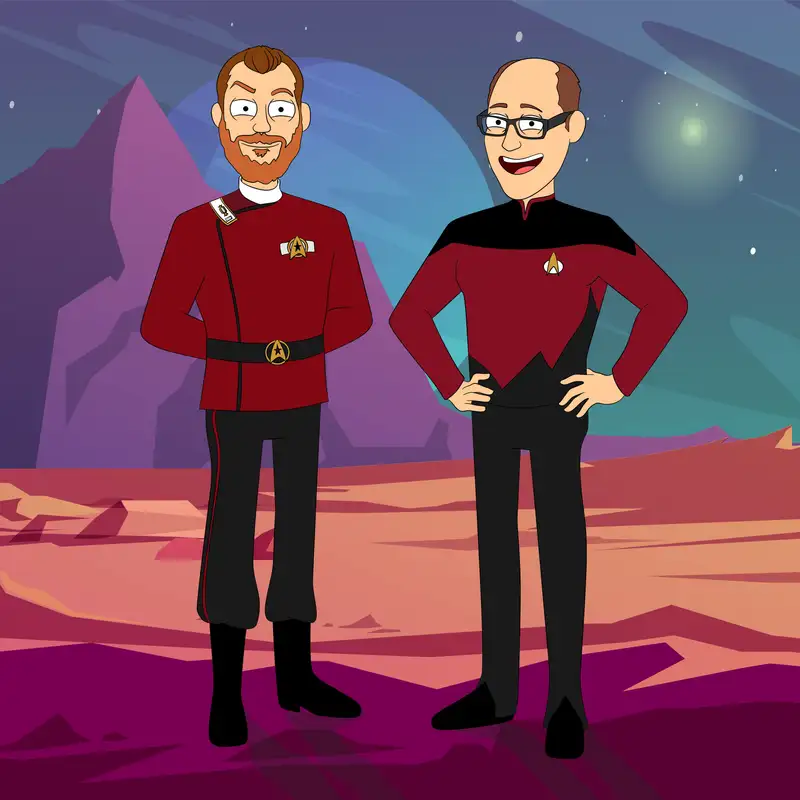
Episode 102: Remembering Walter Koenig & Patrick Stewart
Rob: Hello and welcome everybody to a very
special, out-of-the-blue Subspace Radio.
No, there is no new series coming out.
No, there is no new movie coming out.
We are in a limbo state waiting for
not only the new series of, uh, uh,
and final series of Starfleet Academy.
But we thought we would get back
together for a very solemn occasion.
It is me, Rob,
Kevin: and me, Kevin.
And we are here to celebrate the lives
and mark the passings of Walter Koenig
and Patrick Stewart in one week, Rob.
What are they doing to us?
Rob: Horrible, horrible
week for Star Trek fans.
Um, uh, tributes for two, uh, giants
within the franchise and two wonderful
human beings from all accounts.
Walter was 90 years old and,
uh, Patrick was 82, I believe.
Kevin: Before we get into, uh, discussing
these icons of Star Trek, uh, I'd like
to take a couple of moments to just,
like, check in of, like, have you
been watching any Star Trek lately?
What's going on with your fandom?
Are, are you looking at
other things at the moment?
What, what… what…
How are you spending your pop culture
Rob: I'm g- I'm, I'm
currently seeing other people.
I've been, um, uh, I've been, uh, getting
into the latest season of Rings of Power.
Season three is out.
Kevin: I've gotta catch up.
I watched the first season and, and
have not watched the second yet.
So I've got now two full seasons of Rings
of Power, and I've heard It gets better?
Rob: Season one of Rings
of Power was a bit rough.
It was a little bit rough around
the edges, um, to get through.
Season two was a lot better, and this
season is, um, very good as well.
So season two and three have, um,
uh, almost redeemed of the rough
nature of season one, which was,
Kevin: Well, good.
I'm looking forward to dipping back in.
'cause I, I do, I do like the Lord
of the Rings world and and mythology.
And, you know, despite what's been said
against it, I thought that, uh, season
one was at least a feast for the senses.
It was just r- really beautiful.
Rob: Could see where they invested
the money, and that money was, uh,
well spent on the, the, the look
of it was absolutely beautiful.
And to bring some new stuff to it, but
still in that tradition of the world that
has been built up from the Peter Jackson
films, uh, they connected to that, but
finding their own, uh, uh, style as well.
And, uh, I've done a little bit
of Dexter: Resurrection as well.
I, I enjoyed season one of that.
Season two has started.
Um, he's now moved
Kevin: I am not Dexter
literate, I'm afraid.
Rob: Um, it was, yeah, it was
a disappointing f- season final
episode of the Dexter regular season.
I didn't do Original Sin, which was,
uh, like the origin story of him.
There was also, uh, one where
he was in, like, the winter
wilderness, which I didn't get into.
But, uh, Resurrection is sort of, like,
back in the Dexter form of its prime.
But yes, how about you?
Anything you are, uh, yumming up?
Any Star Trek that you've been yumming up?
Kevin: Well, uh, always,
always going back.
And, like, one of the things is because
there's no new Star Trek, I have canceled
my Paramount P- Plus subscription for now.
And that means that when I do wanna
dip in, back into Star Trek, I am
rifling through drawers for Blu-rays.
And so I'm in the process of, like,
ripping all of the episodes off of my
Blu-rays so that I can have them on a
media server at home and have, like,
uh, my easy access to whatever episode
of Star Trek I want at any given time.
So that feels like a, a change.
Like, it, it's been the better part
of a decade that there's, there's…
I've always had an active subscription
to a streaming service that had all
of Star Trek on it, and that has
gone away now, which is a change.
In the lead-up to Christmas,
there's also a bunch of, like,
Star Trek stuff coming out.
There's new comics, there's new books,
and I've got a couple of things here.
Like, I've got, uh, this is The
Star Trek Archive: 100 Objects and
Stories from the Final Frontier.
It's this, this lush hardcover
coffee table book that is just, like,
Rob: very retro cover as well
Kevin: Yeah, yeah.
It's, it's really cool.
Um, give me a, give me a number
between one and, uh, and, uh, 189
Rob: go 42, the meaning
of life and everything.
Kevin: 42.
The object on page 42 is the MEGO
action figures, uh, classic toys.
So these must be some of the first
Star Trek action figures that
were made for the original series.
And you can see they have, like,
these a- amazing lush photography
of, of these things, and then a, a
little blurb explaining the kinda,
the story behind these objects.
And as you can see, some of it is,
like, some of it is, is, um, fan
paraphernalia and and there's also, like,
props from within the, show as well.
It's a blend of both things that
I'm, I'm enjoying just re- reading
a random entry about once a day.
Rob: I am hoping that in there
is the, uh, infamous, um, uh,
uh, Mr. Spock hat or helmet.
Kevin: In there.
The, uh, the cover promises that
some of the things are weird, and
you wouldn't get away without the hat
with the police light on the top of
it, yeah, uh, that we saw famously
in, uh, uh, s- uh, in Lower Decks.
Uh, another, another lush book
here is, uh, Star Trek Timelines,
Rob: Gorgeous
Kevin: It is a, it is a map of
all of the, uh, time shenanigans
that go on in Star Trek.
Um, and, and so y- you can see,
like, some of them are, are, they
have, like, diverging paths and,
you know, incursions into different
timelines and, and they, they, uh,
chart them across multiple episodes.
Um, and some of them are quite
timey-wimey, as you might say, but
there's also a lot of just, like, what
is the, the timeline of James T. Kirk
and, or in this case, Jean-Luc Picard.
There's a big two-page spread of
Jean-Luc Picard and his life and
times as, uh, as, uh, covered
in the various Star Trek series.
Rob: I'd assume all the cap- I assume all
the captains would get at least two pages.
Kevin: Yeah.
It reminds me a lot of an old book
that I had called s- The Star Trek
Chronology that was just kind of, like
a beginning of time to end of time
timeline of everything that we know
happened in Star Trek, so you could
see events, like, kinda get together.
And this one kinda does the same
thing, but rather than doing
it beginning to end, it does it
more, uh, kind of topic by topic.
Rob: Right.
Kevin: I got one la- last,
uh, gadget to show you.
This is the Star Trek Tr-
uh, Ultimate Trivia Deck card
Rob: Oh, 400
Kevin: with 400 questions.
Every card has an easy question
and a hard question on it.
And,
Rob: only two, easy or hard.
No medium?
Kevin: Y- well, the idea is you, you,
you make yourself feel good about
yourself by answering the easy question,
and then you don't feel so bad about
getting the hard question wrong.
I've been batting close to 100 on the
easies and about 50/50 on the hards.
Do you wanna try one?
Do you wanna try a card?
Rob: Sure, sure.
Kevin: This is from the… this is a
blue card, which means it's technology.
Uh, and I'm covering the answers for
myself as well so that I don't spoil.
I, I'll have a go if you, if you, uh,
are at a complete loss on one of these.
So easy question.
Uh, it says Easier.
They're, they're like, they
acknowledge it's easier.
It's not necessarily easy.
True or false: Jaylah makes her home in
the U.S.S. Franklin in Star Trek Beyond?
Rob: Oh gosh.
Kevin: Yeah.
The m- much loved movie, Star
Trek Beyond, uh, you know, it
had a bit of Beastie Boys in it
Rob: it did have Beastie boys in it, yeah.
I'll
Kevin: This is the… Y- yes, true.
True is correct.
All right.
Harder.
Rob: That.
harder harder
Kevin: What, is the registry
of the USS Franklin?
We've got multiple choice
here, Rob, multiple choice.
A, NX-326; B, NX-587;
C, NX-986; or D, NX-125.
I don't mind saying, Rob, I
would have no hope with this
Rob: No, I'll, I'm just gonna pick B?
Kevin: B?
Uh, incorrect, I'm afraid.
It is A, NX-326.
The NX-326.
There you go.
That is, that is, uh, that is a
fun time for the whole family, Rob.
Rob: Or at least those who like Star Trek.
Kevin: All right, let's talk
about these fallen heroes of ours.
Where do you wanna start, Rob?
Rob: Let's start with Walter.
Let's start with Walter from, uh,
uh, joined the show in season two.
Um, was brought in to bring in,
uh, that famous youth demographic.
Kevin: Yes with the, uh, the wig that made
him look like a member of The Monkees and
Rob: a, wig.
He was already starting to lose his hair.
Kevin: Yeah, and a fun accent.
Look, I don't know if they had
him wearing a wig because he
was losing his hair back then.
Maybe that's true.
Maybe you've read that somewhere.
He did eventually lose his hair
and, and wore a wig in most of the
movies and, and, other appearances.
But, I feel like everyone was wearing
a wig on that show except maybe,
uh, maybe not the, the top three.
But yeah, like, not uncommon to be,
uh, be wigged as a Star Trek character.
Rob: From what I've read, um, and I can
say it is gospel 'cause it was online,
um, he had s- like a wig to support
and then he grew it out himself and
he was able to do it with a comb over.
Kevin: Ah, right, right, right.
Rob: But then in the, but
then in the movies he, uh, was
most definitely, uh, bewigged.
Kevin: I, uh, I also, I heard that
the character changed direction a bit
between season two and season three.
He was saying in one of the interviews
I was watching with him recently that,
uh, the season two is very full of
those Russian jokes where he would
like, on behalf of his motherland, take
credit for every invention and, and
cultural phenomenon in the universe.
And like, "Oh, yes, that
was invented in Russia."
And, um, and that, uh, somewhere between
season two and season three, Gene
Roddenberry came to him and said, "Look,
I think that's juvenile. We're taking
that out. We're not get- we're not doing
that anymore." And so, whether it was
Star Trek in general or the character
specifically, they got a bit more serious
and played a bit more straight with, uh,
with Pavel Chekov in the third season.
That might have had something to do
with the show moving to a late-night
time slot as well, that made it
kind of out of reach of that youth
demographic that they were going after.
And so the reason Chekov came onto the
show kind of vanished for season three,
and so they were left with nothing
other than to treat him as just another
character, whereas I think he was,
he was brought in originally as like
a, a, a, I don't know, a flashy at-
attractor for a certain demographic.
Rob: He definitely, he definitely took
on, uh, the youth role in sort of like,
um, always being a bit hot-headed, um,
being the one to fall into romantic
Kevin: off half-cocked
absolutely all the time,
Rob: getting in romantic situations.
And, um, uh, I, I watched an episode
that was recommended to me by, uh,
Rick, uh, Kanzaras, who's a huge
Star Trek fan, got his own, um,
uh, uh, podcast stuff on YouTube.
Check him out.
I did, um, did a show with him at
Edinburgh Fringe a couple of years
ago that he was running called Ba-
uh, Star Wars Versus Star Trek, and
I had to, to debate whi- which is the
better, uh, franchise, and I was on
both sides throughout my appearances.
Um, but he mentioned an episode as
one of the… he's going through
each season, and they're doing
sort of like the highlight episode,
Kevin: I'm curious which one He chose
I wonder if it's the same one I chose
Rob: He chose two, um, for each one
for, for each- And for Chekov, he
chose one that we have reviewed before
and I went and watched, and they're
two back-to-back ones from Season 3.
So the first one was Specter of the Gun.
Kevin: That, uh, I, that was, that is my
favorite Pavel Chekov episode, I think.
I think that gives him the most
to do as a character, even though
he dies halfway through it.
Rob: He has so much to
do up till that point.
And the other one he recommended
was the one immediately afterward,
Um, something of the Dove.
Kevin: Oh, Day the Dove,
Rob: Day of the Dove.
Um,
Kevin: Yeah.
That's the one where it's
established he, uh, he, is a fan
of Klingon women and their muscles.
Rob: Which is one of my
favorite lines from Star Trek
V: The V- The Final Frontier.
Um, so I watched finally Spectre
of the Gun and gosh I loved it.
Kevin: It's so good, isn't it?
Oh man, season three of Star Trek
gets a bad rap but that like, to me
that is a leftover season two episode.
It is that good.
Rob: I love the design of it.
I love the red sky.
I adore the red sky.
I love how 1960s surreal it is.
It's like the Aven- like The Avengers,
the British show with Steed and
Peel, um, which sort of like did
that heightened reality and it was
sort of like techni- Technicolor,
um, uh, psychedelic type stuff.
I love how you only get
portions of the set.
Um, I love how that blood
red sky is always there.
The performances of the
Earps are so robotic and
Kevin: Oh, I know.
It's so stylized.
Um, and on paper, like they, they… Like
there's a line where they say there's
only bits and pieces of this Western town.
And on paper you're like, "Okay, so it's
a backlot shot at unflattering angles
that reveal that most of the buildings
are, are just facades." Um, that
sounds like a way to save money, right?
But then you watch the episode
and you realize no, like that
was done for artistic effect.
And there are like clocks hanging
in midair and signs on windows.
The window pane is not
there, but the sign is there.
And in the remastered version, you
can just barely make out the fishing
line that is holding up the sign that
is on the window that's not there.
and that, stuff is like they went
above and beyond to make it creepy.
Not just a Western town, but
disembodied parts of a Western
town floating in midair.
Uh, in the 1960s for an episode of TV that
would, that as far as anyone working on it
knew would be there and gone the next day.
It's amazing how much art-
artistry is in this episode.
Rob: Um, I, yes, and I adored,
um, the fact that, you know, this
was the era in American television
of the Westerns were king.
And so to make space for Star Trek
to come in everyone knows it was
pitched as Wagon Train in space.
But to have that mashup of
original, you know, those old
scientists Star Trek in a Western
setting, a perfect mashup together.
A beautiful symmetry there,
which I really loved seeing.
Um, I hadn't seen Scotty
with that hair design before.
It was all- it was more of an updo,
which I found really, really cool.
I loved the portion which we talked
about solving the problem of let's
create a knockout gas, and so
everyone has their tasks to do.
Um, the shot you told me about,
and I remembered it when it was
happening, they had to believe that
the bullets wouldn't hurt them.
So the shot of the, the Clampets
firing into them, and you have
the back of them and the bullets
going through the… Amazing shot.
Incredible shot.
And using non-violence.
And for Kirk to use non-violence, 'cause
he's always pitched as, oh, he's, you
know, shoot first, ask questions later.
Um, beautiful thing about going, "No, we
need to show that we're above this to this
species," um, that we have evolved as a
species, and I found that magnificent.
And of course, the gags about,
"I'm quite liking this captain."
Kevin: Yeah.
Chekov, "We, we, we must always,
uh, maintain good relations with the
natives," he says as he's m- making
out with the chick in the, in the bar.
Rob: And I love the fact that like,
the, the, you know, Sylvia and him
are going hammer and tong and Kirk,
the dog that we know he is, looking
over quite disapprovingly to Spock
and he goes, "Yes, well, the young
people." I found that hilarious.
Kevin: It's so good.
Uh, yeah, the, the, the scene where he
dies at the end of it, of like sitting
on the bench with the girl who wants
to get him to propose to her, so she's
showing the cloth that she bought at
the market and wouldn't it make a nice
wedding dress, and just that stuff.
You get glimpses of Pavel Chekov as
a character that I feel like we never
get that close to Pavel Chekov almost
ever again, ever again, uh, arguably.
Um, and even there he's
like, he's guarded.
Like he's, he's enjoying the fantasy
and then when she pins him down and
says, "We should get married," like
he has enough principle that he goes,
"No, it's absolutely impossible."
Like he could go along with it.
He could have a very nice day
by going along with it, but no,
there is a, uh, there is a line
that Pavel Chekov won't cross.
He won't lead this fantasy woman
on that far, and he stands up and
he goes, "No, it's absolutely…
It would be absolutely impossible."
And just there, just in that, that
moment I feel like we get to see,
um, a third dimension of Pavel
Chekov that we don't often get.
Because he really was, he was,
he was cast as a day player.
His lines were often there as spice
and comic relief, uh, or to be kind
of a, a recurring red shirt who would
get himself into trouble through
his hot head and inexperience.
Uh, and it wasn't until the movies
with Star Trek II where he, he gets,
uh, he is, he is Khan's plaything.
And Star Trek IV with the nuclear
wessels and he, he, you know, he's
questioned and "What's your name?"
Uh, "My name?" No, your name."
"I, I do not know your name." Like
Rob: If you play
Kevin: the Abbott and
Costello comedy of that.
But
Rob: "Can I go now?" Oh
Kevin: Yeah, yeah.
Um, yeah, so the movies, e- especially
those even-numbered ones, did start to
give him some, some stuff to do, but
even then it was often comic relief.
It was a two-dimensional character.
And way back here in the 1960s, it
was fun to see them actually, like,
give the character some beats, some
moments, some breath, and some life.
Uh, and, uh, it was amazing to see how
Walter Koenig, as even such a young
actor, make the most of those moments.
Like, he was fully committed
and believable, uh, a- as a,
as a real character back then.
And to me, that is the thing I
remember most about Walter Koenig,
is he was, he was in with both feet.
Like, he was in headfirst.
He was a believer in genre fiction,
so much so that he wrote an episode
of Star Trek: The Animated Series.
Rob: He was like friends
with Harlan Ellison?
Kevin: Yeah.
He was a collector, like some of the…
Late in his life, some of the interviews
that you can watch on YouTube, he always
had this, like, wall of figurines behind
him, uh, that feels like one of the
walls that you and I have in our rooms.
And so he was one of us in
that he knew what it was like
to take this stuff seriously.
Maybe not Star Trek specifically, 'cause
he had lived Star Trek from the inside.
Uh, but stories are told of him at
conventions, like, getting up from
his signing table and walking the
show floor and actually taking an
interest in all the paraphernalia that
was being sold there, uh, in a way
that Star Trek actors often don't.
They often come in and go, "Look, I, I was
cast to do a job and I discovered what a
beautiful family Star Trek is, and what a
great, uh, body of work it is to be a part
of," and yet they still are not themselves
fans of it in a way that I feel like
Walter Koenig, if not for Star Trek, for
genre fiction in general, definitely was.
Rob: Well, that and like he, um, was
always within-- Like the, the sci-fi
community is very much embracing and
we are very, you know-- It's very hard
for mainstream actors or mainstream
people to accept genre actors outside.
But genre, genre, uh, community goes,
"You can stay with us." And so Koenig
went on to do, uh, a, a reoccurring
role of, to great acclaim in Babylon 5.
Kevin: I watched a couple of those
episodes this week too, I must say.
I went and watched, uh, "Mind War,"
Babylon 5, season one, episode six,
which is his first appearance, and
season five, episode 13, "The Corps
is Mother, the Corps is Father," which
was his final appearance on screen.
The character does have some further
adventures in some considered
canon novels that I have not read.
But, um, it was interesting to me that
these two episodes that bookend his
on-screen, uh, appearances as Alfred
Bester, they are kind of the same story.
In both of these episodes,
Bester is sent by Psi Corps.
He…
For those who don't know the show, he
is a, he, uh, Alfred Bester is a very
high-powered s- uh, um, telepath who works
for, uh, a group called Psi Corps, which
is this organized kinda law enforcement,
uh, group made up of telepaths, and
they work in the Earth Alliance.
And, uh, being discovered as a telepath
kind of requires you to join Psi Corps.
The, the, like, uh, humanity does
not tolerate unregulated telepaths,
and so they must all join this
corps, and it becomes kind of a
family and a community for them.
And in the first episode, Bester,
uh, comes to the Babylon 5 station
in pursuit of an unregulated telepath
who has left the Corps for reasons to
be, uh, teased out through the story
that reveal that this unregulated
telepath is not just any telepath.
He is becoming a super-powered being
that is evolving beyond, uh, human form.
Um, and then in "The Corps is
Mother, the Corps is Father,"
the very same thing happens.
A rogue telepath leaves Psi Corps and
goes to Babylon 5 and is in hiding there.
Bester has to come after him,
hunt him down, and discover that
he is not just any telepath.
He is… He has superpowers that
make him dangerous, and eventually
they have to take him down.
Um, and, and, uh, there are obviously,
like, differences of context and, and
how far the character has come, but the
fact that they tell the, the same story
effectively at the beginning and the end
of this character's run, and I guess if
you're a close fan of the show, you revel
in how the character responds differently
to that very similar situation given
all the water that's under the bridge.
Um, but yeah.
I mean, the o- the other thing that
really stood out to me in watching these,
I have not re-watched any Babylon 5 in
a long time, was just how, um how high
skill Walter Koenig is compared to the
average Babylon 5 actor, that when you
watch Star Trek with Walter Koenig in it,
you're like, "Oh, yeah, he holds his own."
He's, he's… He was cast as
a day player, so he's not the
star, but he holds his own.
In Babylon 5, he blows everyone out of
the water, and half the people around him
are embarrassingly bad in their roles.
I won't name names, and I did enjoy that
show, but I think what I have learned in
hindsight is, A, Babylon 5 does not age
well, but B, Babylon 5 is good not for
its performances or its production value.
It is the sweep and, and great arcs
of its story and its storytelling that
make Babylon 5 a worthwhile watch.
If you parachute in, into any random
episode of Babylon 5, it's pretty
painful at times, I have to say.
But Walter Koenig made it better
through his skill and his craft.
Rob: I have heard that.
I have heard it's more, yeah, the
arcs are what impresses the most.
Um, it does, does, hasn't aged well,
but Koenig's work was, uh, incredible.
Kevin: He plays a very different
character than Pavel Chekov,
who is kinda happy-go-lucky.
The actor himself often, like,
introduced himself as, "I'm real
cute. You should get to know me."
Like, he was very self-conscious of
the fact that cuteness was what he
brought to the table a lot of the time.
There's nothing cute about Alfred Bester.
He is sinister and slippery like a snake.
And in that sense, watching Walter
Koenig play such a different color of
character is itself kind of fascinating.
Rob: Well, he was, you know,
he was a, an accomplished actor
as well as a, a drama teacher.
You know, he, he taught for a number of
years, uh, taught acting, screen acting.
I think, believe it was UCLA
or one, a, a university, um,
in, i- in, uh, Los Angeles.
So he, yeah, no, uh, not just
a pretty, uh, pretty cute face.
Kevin: Some of the last stuff he did, uh,
that I got to watch was his appearances on
The 7th Rule, uh, podcast and, and video
series that you can catch on YouTube, uh,
with Cirroc Lofton, who played Jake Sisko.
And, uh, they have… They started,
I think, by doing a rewatch of
Deep Space Nine, uh, and, and
kind of Cirroc kinda reliving and
rediscovering that thing he helped
make when he was a much younger person.
And they have moved on to other
series and, and movies of Star Trek.
And, and, uh, to their credit, they d-
they aren't just watching it themselves.
They bring in cast members from those
various shows when they watch them.
And so when they sat down to do their
Star Trek original series, uh, I'm you
might call it rewatch, for them, it
was a first watch, uh, they brought in
Walter Koenig, and, uh, the very first
episode, they watched "The Cage," so
they watched the pilot, which, you know,
was made a y- two years before Walter
Koenig even got involved in Star Trek.
And then they jump to the
second season and watch a bunch
of second-season episodes.
Uh, I don't know if it coincided
with Walter's illness, but that,
that run of videos does kind of
peter out at a certain point.
So I don't think they get all the way
through season two, and they don't get
onto season three as far as I know.
But what's there is enjoyable
to watch, and it's fun to watch
Walter kind of rediscover his work
and remember so much about it.
And a- again, watching, like, what he paid
attention to, what he takes joy in, it's
not just the I was a working actor stuff.
It is… He is very much invested in
the characters and the world and the
reality that they were making together
and is fascinated by the details of that.
So he was great to listen to.
It's also fun to listen to Walter…
fun, I'm not sure is the right word.
It's fascinating to listen to
Walter muse on life in general.
He talks a bit, uh, like when they
were announcing this, that, "Look,
I'm an old man. I don't get out much
anymore. Um, and, and this is just a
way to spend my time and connect with
other human beings, which is something
I don't get enough of anymore."
And you, you're like, "Aw." You feel
a little sad for him because you
realize, at least at times, Walter
Koenig was quite lonely in his old age.
And, uh, we understand he lost his,
his son quite tragically at a certain
point and then lost his wife, and
so by the end, he was quite alone.
And, and re-engaging with the
fandom was one of the ways he stayed
connected with other human beings.
In, in the, that first, uh, episode 266
of "The 7th Rule" where they're talking
about "The Cage," they, they're talking
about the story where they're like, oh,
one of the things that these aliens who
give Captain Pike these visions of, of
ideal lifes that he could live within
if only he agreed to stay there caged
as an animal within their menagerie, um,
one of the lessons that is talked about
in the text of the episode is that if
you l- allow yourself to disappear into
dreams and disappear into the past, you
forget to be creative and to be ambitious
and to do something with your life.
And, uh, during the review, Walter Koenig
kind of leans in and goes, "You know what?
Uh, that is very true, and I can tell you
that from personal experience," he says.
That one of the things as an old man
is he has to, he has to resist the
temptation to just live in the past
and, and just rewatch his old glories.
Uh, a- and he needs to still remain
an active participant in life.
Um, so the fact that he was lonely at
times is, is tragic to think about, but
also that he was, he was seeing the risk
of that and doing something about it and
staying connected and staying active I
think makes me happy with, with, uh, with
where he ended up and kind of, um, uh…
I don't think it is a tragic passing.
I think he, he, uh, he lived
a happy life, uh, and I, uh, I
think any of us would be so lucky.
Rob: He, you know, as I like
to say, he had a good innings.
Uh, he lived 90 years.
He faced his tragedies and, um,
uh, low points of his life and his
career, but he had so many highs.
And to know by the end of it that you
were loved and adored and remembered
and you were connected in that way,
um, and making the point to go out
there and do that is a wonderful thing.
Kevin: And did it without
laying it on thick.
Like, I feel like right up to the
end, he also… He spoke truth.
He was quite, um, quite, uh…
He didn't sugarcoat anything.
He spoke plainly and told it like
it is about him- his own work and
about his, the show he was a part
of, the franchise, his fellow actors.
It was nice to hear him, you know, go,
"You know, Bill didn't treat us," or,
"William Shatner didn't treat us all like
family, but that's not what we were doing.
We were day players.
He was the star.
He was a magnificent star.
He did incredible work.
I won't listen to anyone who
criticizes William Shatner's acting.
It was incredible.
The show would not have been
as successful as it was without
him, and I owe him my livelihood.
Um, but was he, were we best friends?
No.
At times he couldn't remember my
name, and that's perfectly fine.
That's just the nature of the industry
and the relationship we were in."
Uh, and hearing him, like, tell it like it
is like that was very refreshing as well.
Rob: A bit of a s- a
s- uh, a, a divergent.
I was watching yesterday the, um, uh,
na- uh, Dropping Names podcast with, um,
with, uh, John Carpenter, who I adore.
Absolutely adore John Carpenter.
And he is such a wonderfully
bitter, cynical old man after how
he's been treated by the studio
system, and he's, like, he's got
a sharp, sarcastic sense of humor.
Um, but they were talking about, you
know, meeting people within the industry
and meeting people within… He calls,
uh, he calls executives pirates.
But he was talking about, "Yeah,
I met Bill. I met Bill Shatner one
time at a convention," you know.
Um, 'cause he's, like,
82, but Shatner's 95.
So, so he's still a young man
compared to Shatner, and he goes
up to talk to Shatner, who's
just looking down on his phone.
And he goes, "Uh, uh, hi, Mr. Shatner.
I'm, uh, John Carpenter, just came up
to say hello." And not even looking
up, he goes, "Nice to meet you."
And Carpenter went, "Well, screw you."
Just the hierarchy within fandom as well.
Jo- John Carpenter, who's done
some of the greatest sci-fi
horror genre films of all time.
The Thing is one of the greatest
movies ever made, for heaven's sake.
Um, and there's a hierar- Bill
Shatner's in his own w- own universe,
and we're all just existing within it.
Kevin: Uh, anything else
to say about Walter?
Rob: Look, my first introduction to him
was through the movies, so the highlights
for him, he does incredible work, like
you said, in, uh, the even movies.
Like Star Trek II I think is
his best work in the films.
He has so mu- he's given so much to do.
The, the, the battle within his soul,
um, to come out of at the other end.
His sense of humor is just
elevated in Star Trek IV.
Um, just beautiful moment when he's
brought out of his coma and, and Kirk
says to him, you know, you know, "Name,
rank." And he goes, uh, "Name, Chekov.
Rank, admiral."
Um, yeah, he's beautiful in that.
Kevin: Yeah.
I, uh, his, his participation lessened
in Star Trek VI, but I still just
loved the, "Only in the sides of
my head," sort of the the stuff
Rob: The comic r- he is
made the comic relief.
There's old c- Russian saying,
"Shoe fits, uh, Mr. Chekov." And
still one of my favorite lines,
"Guess who's coming to dinner?"
Kevin: He was… I think he was, he was
disappointed by that stuff because it
was kind of going back to the old well
when he had… He was given so much
to do in the, in the previous movies.
But yeah.
It was… He t- tells a, a story
frequently about Star Trek Generations,
which was his last appearance, where
he, he was brought back, um, with,
uh, with Scotty and Captain Kirk
on the bridge of the Enterprise-B.
Um, and originally that, those scenes
were written for, I believe, Bones
and Scotty, if I'm not mistaken.
Uh, and so a lot of, uh, the Bones
lines were then put into Pavel
Chekov's mouth, and he's like, "Yeah,
I wasn't even really playing my own
scenes. I was just saying the lines."
But he's got a beautiful moment where
he goes, "I was never that young,"
when he's talking about, uh, uh,
Sulu's daughter who's at the, uh,
at the helm of the Enterprise-B.
And, uh, And, um, yeah, Kirk leans over
and goes, "No, you were younger." uh, and,
just that stuff was really, really lovely.
Yeah.
So, um, I don't think there was
ever, uh, a regrettable moment in,
in Pavel Chekov's kind of outings.
Like, a lot of characters have
embarrassing moments that we look past.
I don't think they ever did
the dirty to Pavel Chekov.
Rob: think so.
I don't think so.
He held himself so well.
He, uh, navigated his way through the,
the landmine that is, um, you know,
Cold War America-Russian relations.
He held, held his head high.
Kevin: And, uh, so if, if that wasn't
enough, a, a week later, just as we were
sort of c- collecting ourselves and our
memories of Walter Koenig, we got the
news that Patrick Stewart had also passed.
This one was more of a surprise, I
understand, that Walter was known to, you
know, have bowed out a lot of, of a lot
of public engagements and was known to
be unwell and that his time was short.
Um, but Patrick Stewart, it was a
bit more of a surprise, I think.
Uh, it, it happened quickly and
privately and, uh, and a lot of
people were shocked by this news.
Rob: He was, yeah, he'd, he'd only
been finished filming, uh, the
most recent, uh, Avengers movie
within the last year and a half.
And yes, from what we heard, it was a
double whammy of a, an aggressive form
of Alzheimer's and a, um, another disease
that I can't remember, but it, it, it,
it, it got hold of him very, very quickly.
Kevin: Yeah.
Patrick Stewart, I, I mean, in some
ways he is my favorite… In some ways.
I think I, I, I can say unabashedly
he is my favorite captain.
In part because he is an unlikely
lead of a series in a way,
especially if you watch the start
of Star Trek: The Next Generation.
They write him deliberately unlikable,
like it is right there in the text of
the pilot of the series that he will be
unlikable, which I think now in hindsight
I can look at it and go, "Oh, that is
intended as the start of an arc." You give
a character an unlikability like that,
you're like, "Well, because we're gonna
take him on a journey and he is going to
be changed by his experience of captaining
this starship full of families."
That's why they put in the first episode
that he is not a family man, Riker.
Uh, uh, you know?
And, and so there was that.
But also, like, he was, he was visibly
older than Kirk was, uh, um, and, uh,
a lot more analytical and thoughtful.
He was not an action hero, uh,
or at least not cast that way.
Rob: Uh, at least not in
the TV series, not until the
Kevin: Yeah.
Oh, He he, had his moments later
in the TV series as well, but it
was clear they chose an actor of a
type, and the type they were going
for was Shakespearean gravitas, not
a, a lead, lead, leading man type.
Rob: Especially that was the
heavy lifting for for Riker.
He was the, in many ways, that
Kirk-esque type character, so they
could give a, bit more, uh, a bit more
of an alternative option with Patrick
Stewart, definitely with the gravitas,
definitely with his Shakespearean
tone, his trained stage skills.
Um, you know, there's a lot of negativity
towards stage actors from film people
as, as it's described as shouting at
night, uh, or overacting on a s- on,
you know, "You're too far away, you
can't change the angles." That's one
thing that John Carpenter was saying.
But there's a great, uh, Ronald J.
Coleman, who I like watching as well
on YouTube, he's done dissections of
performances and how he breaks down a
Patrick Stewart scene, how he pauses, how
he uses the craft, the skill of acting to
speed up dialogues, slow down dialogue,
pauses, inclinations, moves his body.
There's a, there's a deliberate
nature to it, and it comes across so
smoothly, but there's so much skill.
And Patrick Stewart brought decades
of training, of experience, of,
uh, class, um, to his performances.
Uh, and he brought that to the screen
in a genre piece that was getting a
lot of publicity, obviously, and had a
lot of money behind it for the pilot.
But he definitely, I dare say
the word, elevated things, so he
was not a genre actor who have a
certain, uh, perception towards them.
He came in at a pedigree
that made people stand up.
Kind of like with Doctor
Who casting as well.
There was an era where they went,
"This, you're just a certain type
of actor playing the role," which
is a horrible way of looking at it.
But once the modern series came
along, when people like Christopher
Eccleston was cast, they went,
"Oh, this person has a pedigree of
experience, Academy Award-nominated
films," all that type of stuff.
And Patrick Stewart, although had not made
much impact on a mainstream television
or cinema stage, he did Dune, he did, um,
Lifeforce, he did , um, uh, Excalibur,
but this was definitely his first
break into, you know, mainstream type
Kevin: Yeah.
You can… It's funny that, uh, th-
there is a duality there, especially
in the early seasons of Star Trek: The
Next Generation of, yes, his pedigree
and his skill and his, his, um, just
inherent gravitas did elevate that show.
And at the same time, you can see
him finding his feet and being
a little wobbly in the role, and
learning the craft of television
acting, as you, as you mentioned.
That both things were happening, is he
was making the show better even as he
learned how to do that kind of work well.
Uh, and, um, when he did finally find
his feet around, you know, late season
two into season three, and it got really
good, it was suddenly like, not only did
he bring his wealth of skill, but he had
figured out how to do this particular kind
of role, this particular kind of acting.
And I've… In interviews, he
talks about that time as like,
that is when the character and
the actor really blended together.
He says like, "Picard, I was Picard and
Picard was me. That there was like… I,
I look at those, those performances, and
I g- I cannot tell what is the character
and what is just me playing myself."
Uh, and so, and, and I think that is
kind of w- what endears me to Patrick
Stewart, is that so many of the things
that were admirable about the character,
you realize were built in as they were
attributes of the actor, the man, and they
survived beyond his time in that role.
They… He brought them to other roles.
He brought him j- He brought
them just to the way he lived
life to the very end of his days.
That he, he was not a perfect man.
You can read about his imperfections at
great length in his autobiography, but,
uh, an admirable man for sure in, in
the things he chose to st- stand for and
the way he carried himself through life.
Uh, I, I, I looked up to
him a lot in, in those ways.
Rob: Yeah, that's a very m- well, I
touched on a little bit there, but,
you know, his, his decision to, with
his first marriage, um, ending and his
decision to separate himself and from
his children, and he became pretty much
estranged from them for decades to come.
He said, "I am going to dedicate
my life to my profession."
And so he, and, uh, w- he willingly
sacrificed his uh, his two
Kevin: That's a common story
for Star Trek captains.
Uh, Kate Mulgrew tells the same story
about, um, you know, her relationship
to her kids that were, were very young
when she took on that role, and she
was like, "Like, I can't have it all.
I, I would be kidding myself if I
thought I could, and so I am making
the deliberate choice to prioritize
my career for the good of my
family, but they're gonna miss me.
I'm gonna have a, a less re- uh, less
of a relationship to my children as
a result of the way I am choosing
to provide for them, and, uh, and
that, that is a choice I will own."
Um, uh, and, you know, William Shatner
had a marriage fall apart during, uh, the
filming of the original series as well.
So, um, yeah, I, I think, uh, being
the lead of a, of a TV series, and
especially one that gets as close
scrutiny as, as a Star Trek series, uh,
does come at a cost, and, uh, y- that
was true of Patrick Stewart as well.
Rob: Yes.
Um, uh, but yes, and there's m- many
stories about, like, his attitude,
what he brought from the theater
into the film set and, uh, the
Kevin: We're not here to have fun!
Rob: It's a classic, classic reference.
Uh, especially it was
coming from Denise Crosby.
I think I said, "Well,
can't we have fun?" Yeah.
Um, but I also love the stories like,
um, Jonathan Frakes talks about, uh, he
was one of the, the members of the cast
who c- encouraged him to get involved
in the convention scene and, you know,
connect with the fans in that way,
which Patrick was very hesitant to do.
Um-
Kevin: And he did a bit, but not
as much as f- his fellow castmates.
And in that respect, Patrick Stewart is
a very different Star Trek actor to look
back on than Walter Koenig, where, like,
I talked about how Walter appreciated
fandom from the inside as a fan himself.
And Patrick Stewart definitely committed
himself to the role and the reality of it.
And, and that's not just true
of his Star Trek role, but every
role I've ever seen him in.
He was such a professional that
he threw his whole body and
soul into every role he did.
And so when he is playing Picard, there
is never a hint, there's never, like,
a, a winking or, or a sense of the
actor as separate from the character.
He is all in on it.
And, um, a- a- at least appears to care
about every detail and be committed
to the reality of every aspect of
the show that he is contributing to.
And then… And, and yet
In, when the, when the camera stops and
he goes back to just being actor, there
is still this sense that Patrick Stewart
is still Patrick Stewart, who is an actor
who happened to play Captain Picard.
It isn't… It is certainly his biggest
role, is the thing he will always be
known for, but it, in some respects,
he held himself apart from it, and that
enabled him to take on other roles.
Rob: Exactly.
Yeah, I mean, you know, let's not
forget for the last 20 or so years
he's been defined by, you know, two
roles really from, uh, Picard from the
'80s and '90s, um, and, uh, Charles
Xavier in, you know, the noughties
and, uh, the teens and the 2020s.
Um, to carry those two monstrous,
uh, franchises on your back, um, and
still being able to carry on with his
stage work with the Royal Shakespeare
Company, still playing multiple
Shakespearean roles, Macbeth, Prospero,
King Lear, all that type of stuff.
Um, and that's just as important to
him as, um, keeping up his presence on,
uh, the big screen and small screen.
His work in Frasier, for
heaven's sake, in the '90s.
His guest appearance in
that is a wonderful work.
Um, taking on, like his perception, people
perceived him as being… Especially in
the hideously conservative time of the
'90s, um, that you can be defined as
being gay just because you hold yourself
a certain way, and so he embraced that.
And his first big role after
leaving Star Trek was a film called
Jeffrey, um, a, a romantic comedy
in, during the AIDS epidemic, um,
with the gay community in New York.
Um, incredibly powerful choice for
him to do that and, um, his work in
Frasier playing a gay character, it's
just his… You know, his embrace
of that community and his advocacy.
Kevin: Of the things I admir- admire
about Patrick Stewart is how, um,
how unafraid to be queer-coded at
times when it, when the role called
for it or when society called for it.
It, like, there was never a, a
sense of, of putting up that, that,
um, wall of manliness that would
prevent, disconnect him from his
emotions or whatever was going on
in the, in the role or the moment.
Uh, uh, Brent Spiner on, uh, the
Dropping Names with Brent and
Johnny special edition that came
out recently, uh, a great watch.
They just reminisce about their memories
about the man for, for half an hour.
Uh, highly recommended.
But one… My favorite story in
that, uh, piece, Brent Spiner talks
about his first meeting with Patrick
Stewart, um, when he was introduced
to him as, "I will be the captain of
the ship," and Brent Spiner was great.
And just in passing, um, Patrick Stewart
talked about "the man that I live with",
and, uh, he, he said it in his sort
of, you know, um, theatrical British
way, and Brent Spiner was like, "Oh.
Oh, great.
So this, the, the, the next Star Trek
captain will be played by a gay man.
Isn't that amazing?" And he, he learned
later that nothing could've been further
from the truth in terms of Patrick
Stewart's preferences in that area, and y-
Rob: a bit of a ladies man.
Kevin: Yeah.
A- and yet the, like, he was not ever
afraid to just wear his emotions on
the outside or just, like, uh, be
unguarded in a way that would let
people read whatever they wanted
to read into him at that moment.
Rob: Oh yeah.
I mean, his advocacy for domestic
violence, against domestic violence
and support for, uh, violence
against women, all that type of stuff
with his lived experience with his
mother and his himself with his,
um, you know, uh, deeply traumatized
father, um, is, is powerful stuff.
And his connection with fans, there's
so many videos out there about, you
know, with fans sharing their story
and, and, um, him supporting them and
guiding them and all that type of stuff
is, is just wonderful to, to remember
and what he brought into the world.
And it really is a case of, same with
Walter as well, that this legacy is there.
Like I, I went and watched finally
Measure of a Man for the first time.
Um, and
Kevin: It's early, but very good.
Rob: Very good, and I find it weird within
the first five minutes, 10 minutes, uh,
we hear the word 'sexy' in Star Trek.
It is very, very weird.
Um, espe- and it's got a cold
opener that is really weird.
Like it just, it, there's no… We're used
to cold openers now leading to a point of,
ooh, that's something that's happening.
It just goes, "All right. Okay.
Hi, how are you?" And you go…
Um, but yeah, it's an iconic episode
and I did, uh, tear up at the end,
um, between, uh, uh, Data and Riker.
That's a beautiful little moment.
Kevin: I think my favorite Captain
Picard moment has gotta be the speech
with Lily in Star Trek: First Contact.
"A line must be drawn here. This far and
no farther." And, uh, the, the way he
changes when confronted with his, his own
lust for vengeance and, uh, he, he, talks
about Moby Dick and Lily's never read it.
And, and, uh, that whole scene is
just magic elevated to another level.
Rob: But it's him working, it's him
working with the great Alfre Woodard
as well, who's just incredible.
It's, you know, Jonny
Frakes says it all the time.
You go, "Well, you gotta, if you're gonna
play tennis with someone, you wanna play
with someone, you know, you wanna play
with a pro so, you know, you get better as
a player working with someone better than
you." And he said, "That's what me working
with Pat, you know, I got better as an
actor because I was working with a great."
And you can see that, the two of,
with Patrick and Alfre Woodard is
what the strongest point of that
film is the two of them, their
connection is really, really strong.
Kevin: But if I were to recommend
kind of, um, a, a, a little Picard
journey to go on, the one I went
on, uh, is what I'm calling the, the
Captain Picard tearjerker trilogy.
Uh, starting with, uh, season four,
episode two, "Family," which is kind
of the third part of "The Best of Both
Worlds" where, yeah, where after the, his,
uh, his experience being Locutus of Borg
and very much kind of still in recovery.
It's very rare we get to see a S- a
Star Trek character, um, you know,
emotionally injured by an experience
across episodes, but that, uh,
that was played explicitly here.
And, uh, yeah, going home to La Barre,
France, and the Picard estate, and,
uh, meeting his brother's wife and
his nephew, who, uh, he calls uncle
because, uh, because in their first
meeting, the nephew was a little confused
about, uh, the, the uncle-nephew terms.
Um, sadly, all of those characters
burned to death, uh, off-screen
in Star Trek, uh, Generations.
But, uh, nevertheless, they are
amazing to meet here, and, uh,
the fight in the vineyards in the
mud with, uh, with the brother is
worth the price of admission alone.
And then I'll take us to "The Inner
Light," which I've talked about
many times, many people's favorite
episode of Star Trek: The Next
Generation, season five, episode 25.
Rob: Incredible,
Kevin: Incredible, uh, a wonderful,
you know, lift Patrick Stewart
out of his usual day-to-day on the
Enterprise and put him in a completely
fish-out-of-water situation, and watch
him learn the value of family and
legacy and, um, and then have it all
taken away in the final moments of
this episode and, and live with the
tr- the trauma and the tragedy of that.
Rob: Play the flute.
Kevin: Flute.
The flute which comes back in the
third part of this tearjerker trilogy,
season six, episode 19, "Lessons,"
which I've talked about before.
I, I, I have glibly described this
as the episode where Picard gets a
girlfriend, but this is really about
Picard learning or experimenting with
sharing more of himself with a fellow
crew member than he normally does,
and becoming emotionally attached
to, uh, this woman under his command.
Uh, bonding over music,
sharing the Ressikan flute.
This scene where they are together
in the Jefferies tube and, uh, she
plays a little piano and goes, "Look,
the ac- acoustics are perfect here.
Why don't you play something?" And he
just whips out his flute and starts
playing the, the melody from "The
Inner Light," not explaining what
it means to him, but just, like,
sharing it vulnerably like that.
And, uh, she says, "What was that?
I've never heard it before." He goes,
"An old folk melody." And eventually
he does admit what the meaning of it
is to him and all of that, and, um,
yeah, it's a, a, a wonderful episode.
But speaking of, of odd cold opens and
odd ad breaks, this one is full of them.
Lessons is unabashedly just like… it
is not a dramatic episode of Star Trek.
It is, uh, every, every
scene just kind of ends.
It doesn't really end with a dramatic
beat where it's like, "What's
gonna happen now?" Which is, like,
what you're used to in Star Trek.
Every single scene ends with a
swell of the music and a, and a,
a, a lingering, um, dramatic look.
And there is none of that here.
There is… Most of the scenes
end with Picard just smiling
happily, and you're kind of, like,
discomforted by how unusual that is.
And that is the drama of this episode,
is like, "Wow, Picard's happy. That's
weird. Is this gonna work out?"
Rob: And it doesn't.
Of course it
Kevin: Yeah, and it does
not.
But, uh, yeah, watching through those,
uh, and at times having a, a bit of tears
in my eyes, I, I was conscious that at
all times my tears were for Picard the
character, not for Stewart the actor.
In part, that's because of
how good of an actor he was.
Um, I, I… Like, y-
you never see the actor.
You are always seeing the character
when it comes to Patrick Stewart.
But the other thing is, I, I find
it hard to mourn Patrick Stewart
because I feel like he did it all.
He had such a s- a creatively
fulfilling, successful life that must
have been so happy so much of the time.
Like, I, I, I cannot… For me, I don't
know if this is, a personal thing, when
I mourn or I feel the loss of someone,
I am usually thinking about the things
that could have been or will never be.
And when it comes to Patrick Stewart,
I feel like everything he could have
possibly wanted to do, he did, and he left
it all on the field, and it is all there
in a body of work that will live forever.
And so I cannot but
celebrate Patrick Stewart.
Rob: He is, yes.
It's very much a case of he got
everything out of his time in this
space, and he has got a rare thing
that his performances, his work, his
beliefs, his philosophy will live on.
Um, and not many of us can
have that um, that legacy.
Um, and it's a, uh, it's a
beautiful, positive legacy to, to
inspire and carry moving forward.
Um, it's, it's a wonderful, wonderful
tribute to the hard work he put into
his life, the sacrifices he made.
Um, same with Walter.
Walter lo- lost a lot along the way.
Um, but, uh, to bring good and positivity
into the world is a, is a powerful thing.
Kevin: Is there anything you rewatched or
wanted to revisit with Patrick Stewart?
Rob: Watching, watch- watching,
um, Measure of a Man was a, a, a
wonderful experience to finally
get into very early on in his time.
But those moments of, uh, humanity
coming through the cold exterior,
like his interplay with, uh the
JAG officer was very, very stilted.
But that beautiful line at
the end going, "Dinner?"
Um, and his interactions with Data.
And he almost get- Like, he's
there going, "I'm so sorry this has
happened." And Data has that moment
of going, "Well, I'm gonna compete
it," you know, g- g- go against it.
And there's almost this affronted nature
of Picard going, "Oh, oh, well, oh, okay."
But then he goes, "Let's make
this work. Let's make this happen,
that you are more than just, you
know, the sum of your parts."
And it's a beautiful final line of, um,
of, of, of the scientist, uh, going, you
know, "He's remarkable." And they make a
point of going, "Oh, you stopped calling
it it, calling him it." Um, a- and his
beautiful work with, with, with Spiner
and, uh, in that is particularly lovely.
The two of them have a wonderful
connection, and Spiner's
connection with, um, with Frakes
is beautiful in that as well.
Kevin: Yeah.
I'm not sure if they, they entirely
knew it, but this episode to me is kind
of some of the earliest evidence that
Patrick Stewart and Brent Spiner are
the two stars of Star Trek: The Next
Generation and that era of Star Trek.
Yeah.
Rob: Yeah, two very different
approaches to acting, two very
different backgrounds of acting.
Um, but quite similar as well.
Like they both had, you
know, both theater trained.
You know, Spiner had done a lot of,
uh, theater work, um, in rep, traveling
around, but also, you know, on Broadway.
Um, but had done a lot more television
as well, and a lot of pilots that didn't
make it through and, you know, a lot
of options to do other type of stuff.
And Spiner hasn't really been
able to break out into, um, other
franchises or show his range.
He's done quite a bit of, you know, glib
small work that doesn't really elevate
the skills that he has, whereas Patrick's
been able to move on and on and on.
Like my, one of my favorite things
is Brett Spiner said, "I'd really
love to host Saturday Night Live.
I'd love to host Saturday Night Live.
Could you try and get us that?" And
they reached out and said, "Oh, one
of our stars is- would love to host
Saturday Night Live." And, and they
came back and said, "We'd love the
captain." And of course, Patrick
Stewart hosted, uh, Saturday Night
Live and did some iconic work on that,
which has been shared around a bit.
Um, but, but yeah, his, his work, his
legacy within this franchise and how
it's shifted within the seven years,
how it shifted within the movies, um,
his work advocating with the show, n-
not to the same extent as the others.
S- stories like, uh, Marina Sirtis saying
during lockdown, "You know, I lost my
husband and I was in my house alone,
and Patrick was one of the few people to
reach out and just check in on me and, you
know, keep me sane and safe and protected
while I was home alone during lockdowns."
Um, that type of stuff is beautiful
to hear about the, the man he
was and the, the person that
he, uh, uh, he wanted to be.
Kevin: Yeah, that stuff's lovely
to hear 'cause you do, you do get
the sense that i- in Star Trek: The
Next Generation, yes, the crew is
close, certainly as the, during the
seven years of making that show.
But in the years since, there is
everyone and then there is Patrick.
And when y- they would get together,
often it would be without Patrick Stewart
because he is too big of a deal for us.
And you hear some stories from
the movie sets of like, you know,
Patrick's publicist is refusing to
let the, his actor come out of his
trailer until they pay the per diem
fees that have been left behind.
And like, there is definitely…
Like, there was hardball played by
Patrick Stewart and the people who
managed him in a way that is probably
appropriate for an actor of his stature.
Uh, and yet it, it must have separated
him from that group of people.
And so when you hear that, uh, there
were definitely were times when, when
Patrick, like, reconnected and looked
after them and, and took them on
holidays or, you know, were there for
them during COVID in in Marina's case.
Um,
Rob: Or even during, like, during, um,
Picard, like, he had his vision for
what he wanted with that show, and so
he had to- he personally rang each of
the cast and said, "I'm doing a show
again, and y- you're not in it." So
that difficulty said, you know, "I've
got Brent, I've got Jonny, and I've got
Marina in it, but you're not in it."
So they're going, "Okay."
But
Kevin: Yeah.
So you get the sense, like the
business sometimes separated Patrick
from the rest of them, but the, their
relationship was still there, uh, um,
which is a lovely thing to to, to know.
Rob: Definitely.
It's not show friends, it's show business.
But once you get the bus- once you get
the business sorted, you can, you know,
make some friends in there somewhere.
Kevin: Well, thank you for the, uh,
for the stroll down memory lane, Rob.
Rob: Thank you for joining me, and thank
you for agreeing to have a chat about
these two wonderful men and their legacy
w- not only with the show, but with,
uh, the broader world as it, as it is.
Um, and it is… Yeah, I think
that's a great way to look at it.
It's not really a tragedy or a loss.
I think it's a beautiful statement about
lives led to the best of their ability,
and they've faced many obstacles along
the way, but they've achieved so much
and given so much to, uh, the world and
to people, which is a positive thing.
And that's great in the time
that we are in to bring that type
of celebration into the world.
Kevin: Couldn't have said
it better myself, Rob.
Um, I think that's a
lovely note to end it on.
And, uh, if I, do not see you again
until, uh, until the middle of next year
with Starfleet Academy Season 2, uh,
keep well and, and, uh, you know, any
time you want to study up on your Star
Trek trivia, you know where to find me.
Rob: I know.
I, I, I'll, we'll start with the easy
one to make me feel safe, like you said,
and then feel hideously out of pla-
touch when we get to the harder ones.
Kevin: All right.
Rob: You,
Kevin: uh, until then, Rob,
see you around the
Rob: soon.
Take care.