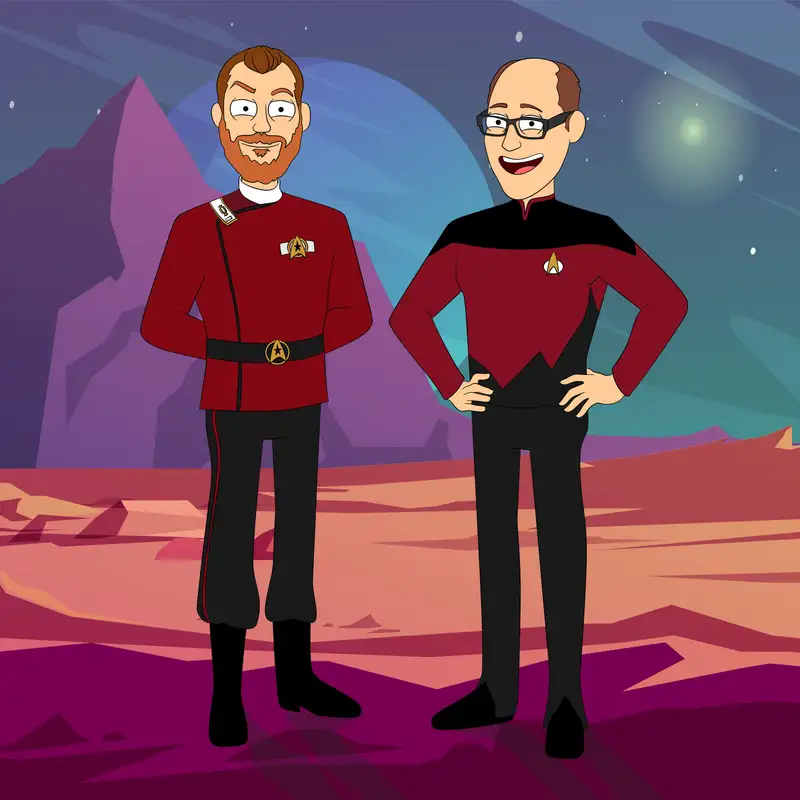
Episode 100: Pets (SNW 4×09 Once La'an a Time)
Kevin: Hello, and welcome
to Subspace Radio.
It's me, Kevin,
Rob: and me Rob,
Kevin: and there's a little more subspace
between us than there usually is.
I'm coming to you from Canada in the
Northern Hemisphere, and, uh, Rob, uh,
you're holding down the fort at home.
Rob: I am.
So we are literally on opposite
sides of the globe down here in
Melbourne and you up there in,
uh, the wonderful land of Canada.
Kevin: It's lucky Starfleet
invented subspace communications
or we would not have survived.
Rob: Exactly.
Exactly.
And thank heavens I'm not on that
penal colony in, uh, New Zealand where
I'd have to hang out with Tom Paris.
Boo.
Kevin: Well, we have a new episode,
uh, each one is precious is how
I'm feeling at this point, Rob.
Rob: Diminishing, diminishing as we,
uh, as we can see right before our eyes.
New episodes of Star Trek are fading away.
Kevin: Well, this time we're here to
talk about Strange New Worlds, season
four, episode nine, "Once La'an a Time."
Rob: The penultimate episode of
this season, and we've got a, uh,
another pastiche episode, and we
have got a sequel to, uh, the, the
episode that kicked this all off.
Kevin: I went back and rewatched
"The Elysian Kingdom," which is,
uh, the episode we talked about in
our, in our secret, not so secret
episode zero of this podcast.
was the, uh, the, it was the show that,
uh, occurred first after I said to
Rob, "How about a Star Trek podcast?
The world needs more of those."
Rob: Two guys talking
about something nerdy.
We need more of that online.
Kevin: Yes.
Yeah, absolutely.
Uh, and, uh, yeah, it was fun to
revisit the show at that time.
It was… You know what?
I'll tell you what.
Despite the, the, uh, fairy tale
shenanigans of that original episode
and, and this week's episode, it
nevertheless felt like much more of a
straight "Star Trek" episode back then.
Like, despite all of the, the
trappings and the hijinks, it was like
people giving orders on the bridge.
It was people trying to science
their way out of a situation.
It felt like damn "Star Trek" already.
And, uh, and I, it, I, I don't know if
I'm tipping my hand, but this episode
did not, um, you know, it had its charms
for sure, but I definitely did not
feel like I had watched an episode of
"Star Trek" by the time it was over.
Rob: No, this was a, a big disappointment.
This was a really- this is
an underwhelming episode.
Um, I was v- as our second last episode,
um, it was very much… It was a very
telling episode to be second last in,
uh, i- in the series to, for us to
go all our hopes and dreams, Kevin,
of, uh, the start of the season.
We were there going, "Maybe this'll
be a season of more consistency.
This will be a season of, you know, really
bring it home for our final two seasons."
And we're getting to episode nine, and
we're going, "Well, this is another one
where we're either, you know, you either
love an episode, you hate an episode.
There's a bit of consistency.
There's not inconsistency." It's
just a, a statement about season four
as a whole of Strange New Worlds.
They've either stuck the landing, or
they've fumbled on, uh, o- on, on entry
at the final, final pose, if they've,
if they've… If I'm anywhere near my
metaphor of gymnastics right there.
It was, it was a, it was a big,
it was a big disappointment.
It was very, very, very sad.
There's, uh, yeah, like you
said, a couple of highlights.
Kevin: Yeah, let's talk about what
we liked and then we can, uh, we
can i-indulge in, in all the things
we did not, that, that us down.
So I'll of all, I l- I am… I really
enjoyed La'an's work, like La'an's
character and characterization.
The fact that she, in many respects,
was the only person taking anything
seriously this episode, and, and
she was to the last a professional.
And, uh, and w- like listening to her go,
"We're staying? Why are we staying?" And,
and refusing to put on the costume and,
and, and, you know, doing just enough fake
crying in order to advance the mission.
All of like, very charming and fun.
And watching La'an happy at the end of the
episode, I mean, we could talk later about
how justified that was, but seeing a, a,
a happy, at peace with herself La'an, I
was like, "Wow, yes, that is a, that is
a character I wish I had another season
at least to get to spend time with."
Uh, we're only gonna get a half
season with her, unfortunately.
But, uh, but yeah, uh, uh, like she,
she was visibly changed, and I liked
both versions of her this episode,
and, uh, by which I mean not Princess
Talia, but the before and after La'an.
Uh, th- they both, like the actor was
doing a great job, and I thought the,
the characters function… the character
functioned well within the story.
Um, so yeah, La'an, I'd say in general,
La'an was a highlight for me this episode.
Rob: Definitely, definitely.
Um, to have that conflict between
her two sides was always, um, gonna
be fun to see, especially how La'an
sees our, our princess character.
Um, but this was definitely, uh,
Christina Chong's, uh, episode.
It's, it's been her season really
of what they've actually wanted
to do, uh, with La'an, and,
um, there could be discussions,
Kevin: was convinced that, that
it was the case, it was that
because they were writing her out.
But, um, w- La'an lives to
fight another day, it seems.
Rob: Yes.
Look, there could be arguments made, and
I'll s- save this for later on when we
get back into the critical side of things,
about the, the impact of this entire
season has been, um, thrust on La'an
about where she stands and who she is and
what she's capable of and what is inside
her, and will she lose control of that?
And it comes to a peak about
her just being happy or sad.
Um, there can be discussions about the
validity of or the, the, whether that is,
again, another sticking of the landing.
But her performance, uh, her commitment,
her range that she showed with her
different characterizations, what she was
going through, um, was wonderful to watch.
And yeah, to give her a moment of
happiness was, um, was, was good to see,
like not controlled or not going, "Oh,
this is just casual," or this is her
unabashedly letting go, being vulnerable,
uh, opening up about her dad and, um, uh,
opening herself up to, uh, you know, not
stabbing Jim Kirk, but dancing with him.
Kevin: What else did you like?
Rob: Um, loved, loved the hijinks.
It was hijinks.
Hijinks were had as, uh, T'Pring
doesn't like them, but we endure them,
um, of Anson Mount and Ethan Peck
doing an incredible job as their,
uh, fairytale characters trying to
fit in very poorly on the bridge.
It's always a, a, a fun sight to see.
Kevin: The comedy worked, give it that.
Rob: It did- That type of stuff,
those shenanigans were great, like
stopping to have a beer, uh, and
getting cheered at, at, at the
Kevin: I, love the, uh, "You must keep
your wits should we encounter more do-
uh, doppelgangers." "Yes, easily done."
they run into Uhura in the hallway.
just
Rob: how he sits on the captain's chair,
like his, like, you know, everyone's
getting angry at Holly Hunter for how
she "disrespects" the captain's chair.
Um, Anson Mount was all over the shop.
So that stuff was fun.
Ethan Peck was great.
Just a nice variety of him
playing a different character,
but trying to be Spock.
There was some lovely subtlety
there with his, uh, acting,
which I was really happy with.
And Anson Mount was just, uh, a
delicious ham, which I love to see
Kevin: Yeah, they got snapped into the
picture frames all too early, but seeing
Pike and Spock attempting to be these
storybook characters and failing, just as
the storybook characters were attempting
to be Pike and Spock and failing, both of
those-- both sides of that was charming.
Rob: Yes.
yes,
Kevin: Uh, Carol, Carol Kane also
just being Benny Russell, the
Duchess Benny Russell, uh, was, fun.
The references to "Princess Bride"
were also, uh, fun in their winking.
Rob: Yes.
Like, "As you wish", I
went, "Oh, that's very nice.
There we go.
That's nice.
That's nice." And they're
going, "Oh, there's a cook.
He's a miracle.
His name's Max." I'm going, "All right.
Okay." Um,
and, uh, we could talk later on
about, um, all right, okay, so she
is written out of the show offstage!
Kevin: Apparently.
Rob: Are you kidding me?
All right.
Okay.
This, like, I know they wanna give
the vibe of old school television,
uh, episodical television, but
I'm going, not, not even a scene.
Not even a m- okay.
All right.
Okay.
This is where we're going, Star Trek.
All right.
Thank you, Strange New Worlds.
Kevin: And like I'm scraping the bottom
of the barrel at this point, but,
Rob: you trying
Kevin: the communication, the, the,
um, the communication call between the
landing party and M'Benga in his office,
the fact that we went back and forth and
saw La'an on M'Benga's view screen, I
thought was really fun and, like, notable
for the fact that at least, unless I, I'm
misremembering, it's the first time we've
kind of seen the other side of a video
call on "Star when, there was no view
screen in front of the person speaking.
And it was really fun the way they cut
from, you know, a shot of La'an on a view
screen, presumably, like, reassembled
from Pike's communicator or something,
uh, uh, uh, it-- from the screen in
M'Benga's office to we're watching it live
and it's like a continuous, um, cut or
continuous shot, uh, was, was really fun.
It made that, that, uh, form of
communication, which is now, like
it would've been futuristic, like
just voice calls, instant voice
calls a-across distances like that
wirelessly felt futuristic when "Star
Trek" first came out in the '60s.
Now it feels mundane, but for a s-
for a second there, it felt futuristic
again in a, in kind of an exciting way.
They didn't have to do
holograms or anything like that.
It was subtle.
It felt like a normal technology
in the world, and yet it was
just a little magical to me,
and I really enjoyed that touch
Rob: That was the real magic.
Not, not, not, uh, CGI fairies
floating in the sky, not a
dragon attacking the Enterprise.
Um, yeah, that, that was a
very cute little, uh, addition.
Very subtle as well.
Kevin: Yeah, yeah.
Anything else that you liked?
Rob: Nope, that's it.
Kevin: That's it.
Rob: Oh, it was so depressing.
Um, yes.
Yeah.
Kevin: I'll say just in general, like, it
was not until I watched it a second time
that I realized how little was there.
Moment to moment on first viewing, I was
kind of enjoying myself and going along
with it, and then it ended and I was
like, "Oh, that's it? That's it? That,
th- that, that's all you had for us?"
Like, it didn't really amount to much.
But moment to moment it was a fun
kind of rollercoaster ride, I suppose.
Rob: Yes.
Yeah, it was a bit of a caper.
It was a bit of a caper.
If you try and understand the
science or the logic of this ship and
what… No, don't, don't even try.
Why, why, why would you try?
Why would you try?
Kevin: Why would try?
Where it's only Starfleet, it's
only Starfleet where like the
science is supposed to be the point.
Rob: Yes.
Yeah, yeah, yeah.
And
Kevin: In The Elysian Kingdom, Hemmer
makes a big deal of the fact that he uses
a, an amazing magic known as science,
and all of the fairy tale creatures
are amazed by his science magic, and it
is a wonderful way of using Starfleet
science in this, this fairy tale framing.
And here it felt like
they did the opposite.
They were like, "Well, no
science can ever explain this.
Guess we better just go along."
Rob: Just go with the magic.
It's magic.
It's, it's magic.
It's, it's a ship, but it's, you know,
this planet isn't a planet, it's a ship.
But it's got magic, and just accept it.
Kevin: make several points of calling it
a ship, but we never see any indication
of what that means in practice.
A ship how?
Is it-- Does it have propulsion?
Does it have machinery?
Is there a power source?
Like talk, give us some
details, like be specific.
Rob: That's what Pelia's got to do.
That's why Pelia's leaving.
She's, she's to do, all that.
Um, especially with The Elysian Kingdom,
there was such an emotional gut punch
at the end, like a real gut punch of the
loss of a daughter and her, you know,
her, and M'Benga embracing her moving
on and him, you know, accepting that.
But with this, yeah, the, there was
no gut punch to, to balance it out.
It was quite… Yeah, like I said,
we've been building up to this the whole
season for La'an of going, "What am I?"
It's not just a case of, "Oh, who am
I?" She's there terrified about the,
the augmentation within her and the,
um, the potential darkness of her, her
ability, you know, the voices she hears
in this abandoned ship, the, the ability
to go and stab someone she cares about.
Um, she's terrified of what she's lost,
and it's just a-- it's been reduced down
to you just, you just gotta be happy.
Um-
Kevin: is such a jumbled mess of ideas.
Th- there's like a bit of she is
magically forced to feel happiness
by swapping emotional states with
Princess Talia in, in their fight.
And there's the message of like
accepting yourself for who you are.
Uh, like when she understands that
Talia loves Prince Dashing knowing
that he's a werewolf and that that is
supposed to like change her in some way.
And neither of those is enough on its own
so they're like, "Let's just throw both
at them and hope nobody notices that none
of this makes any sense." Uh, and yeah,
when she, she comes back from the ship and
she's smiling I was like it's like it's
nice to see the character happy and the
actor's doing a great job of selling but
there's just no story that explains it.
Rob: Yeah.
Yeah.
And stuff like, oh, there's no
character for Pelia because she
wasn't on the ship at that time.
But Kirk shows up and wasn't on the ship
at that time either, but they go, "Well,
we kinda need him there." Um, so they,
yeah, they play fast and loose with
their own logic within that episode.
So that's our new phrase.
Well, that's our phrase that
we've been using for Strange
New Worlds this entire time.
Strange New Worlds, fast and loose.
Kevin: Yeah, I, uh, were not for the
necklaces, I would not have u- uh,
recognized, um, M'Benga's doppelganger as
King They never name him in this episode.
He never introduces
himself as King Ridley.
But he's got the same necklaces.
He's just got a completely different
hairdo, and I guess King Ridley is
living in the forest like Robin Hood
now rather than wearing a crown.
But, uh, yeah, none of that is explained.
It's just kind of glossed over.
King Ridley's standing in the
forest, and once other characters
show up, he has no further lines.
kind of stalks in the background
and then disappears from the story.
And, uh, it, it just-- In a way, it
felt like they were kind of having to
squeeze every character into this and
give them something to do, even if it was
kind of truncated and, and unexplained.
Rob: And you were right as well
about the, like, as soon as the
character shows up, they are
thrown into the, into the portrait.
And literally a case of we've had
them here, okay, let's literally get
rid of them out of the story so we
can focus on these other characters.
'Cause not only do they have their regular
cast of Enterprise characters, they've
got the doppelgangers as well, so that's
double the cast on- you know, only, uh,
Kevin: apart from not having a clear
message of its own this episode,
I also feel like it misunderstands
the message of The Elysian Kingdom.
M'Benga ex- kind of, he, he explains
in his call with La'an, "Hey, the, the,
the, um, Boltzmann brain in the nebula
sent me on an adventure because it
sensed I had difficult feelings that I
needed to work through." And that's not
what happened in that original episode.
That's what we sus- that's what we
think is happening right up until
the end, until twist, it is revealed
this is not M'Benga's fantasy, this
is his daughter Rukiya's fantasy.
And, and the fact that they, they
summarized the original episode wrong
here makes me wonder how close attention
anyone was paying to the story.
Rob: Fast and loose.
Fast and loose.
Um, yeah.
You let me down, Strange Worlds
Kevin: The stuff about, uh, Rukiya's
gone from here and whatever science
she left behind continues to function.
Like, Rukiya was here?
How do we know that?
What d- in, in what way was she here?
What does that mean?
Uh, like, yeah, all-- It's just there's,
there's, you know, big buttery lashings of
script where, where nothing makes sense,
and it's just kind of, uh, story-shaped
dialogue rather than actual story.
Rob: And a lot of hand waving of
going, "Yeah, just, just don't worry,
don't worry about it. Don't worry
about it." And you know, they've
forgotten who their audience is.
Don't you realize Star Trek fans
care about this type of stuff?
We wanna know all the stuff, at least
some sort of attempted logical scientific
explanation, and then we go, "That's okay.
You've, you've at least tried." Don't
wave away it and just go, "Hey, hey,
hey, hey, you're thinking too much." So
Kevin: Yeah.
Uh, Spock's wizard actually casting
spells that paralyzed people, like,
th-that kind of broke my brain as well.
I was like, "I guess?" I mean,
if we accept everything else
that's going on, I guess we have
to accept that as acceptable.
But it, it feels so out of place in
Star Trek, like to the earlier-- La'an's
earlier line of "magic," we're just
saying magic is a thing now, right?
Rob: Ja.
Ja, ja, ja
Kevin: uh, when they, when they froze
the transporter chief in, in there, I
was kind of like, "Ugh, uh, I, I might
have to, uh, I might have to admit
I am not enjoying this right now."
Rob: That's, that's
quite into the episode.
That's quite into the for you to
go, you know, that you've given
it more than I probably did.
Um,
Kevin: of La'an's strongest stuff
was at the start of the episode
before she got into the dress,
and so I was still happy then.
Rob: Exactly.
And we got see
Kevin: it was, the denouement where it
all falls apart because you're, you're
kind of going, "Well, look, I will
suspend disbelief trusting that this is
going somewhere," but when it doesn't
go anywhere interesting or significant,
then I feel cheated for having
attempted to suspend all that disbelief.
Rob: Oh yeah, oh yeah.
But we did get a doggy.
We got a doggy and a, we have got an
animal on the, uh, on, on the Enterprise,
which is a, a beautiful thing to see.
Kevin: An animal on the Enterprise.
I, I don't know if it scans as an animal.
They scanned, M'Benga at the
start, his doppelganger, and said,
"This is not M'Benga." So that
dog, A, created out of thin air.
It is not the duplicate of any other dog.
It is just, is part of, part of
Princess Talia's wardrobe, I guess.
Uh, and but yeah, it's, it's on the ship.
I guess, um, you know, and any fan, uh,
who's watched any amount of press, uh,
appearances of Christina Chong knows that
that little poochie is her real-life dog.
Runa Ewok is the name of the dog.
Rob: Runa Ewok.
Kevin: Yeah.
And it plays Runa, no Ewok in, in the, in,
Rob: Of course.
Well, she's got range.
Um, yes, I've seen she does give- come
across as a, you know, in the press
stuff with her and her dog, I'm there
going, "This is a little bit Paris
Hilton back in the early noughties
type thing of, you know, the dog goes
everywhere." I'm going, "All right.
Okay.
Each to their own.
You've got a great singing voice.
You're wonderful actor.
You, uh, from all accounts
you're a wonderful human being.
If, if this is your thing,
you, you, you be you."
Kevin: That's right.
That's, that's my feeling about it well.
Rob: So yes, um, anything else you would
like to say about Once La'an Upon a Time,
or shall we move on to deeper discussions?
Kevin: like I des- like we should--
I, I should make room for you to have
an, uh, an extra rant about Pelia, uh,
apparently leaving the show off screen.
Rob: Okay.
All right, all right.
So we have had Carol Kane for two seasons.
Two seasons?
No, more than that, about two and a half.
Three and half.
Three.
Yeah, she came at the end of season
one, uh, start of season two.
Kane.
Kevin: Season two,
Rob: So two and a half seasons.
Um, and she's come and
gone as she pleased.
Uh, but she, she hasn't been in
every single episode, but when she
has, she's made a fantastic impact.
Um, this season we haven't
had… We've… It's been a mixed
bag with a mixed bag of her.
We've had some incredible episodes
with her, like with, um, the disaster
episode, her guiding Scotty through.
That stuff was incredible.
Uh, early on it was just her making Doctor
Who references, and that's pretty much it.
Uh, puppet version of Carol Kane
i- was… is a, is a masterstroke.
Um, here she comes in, does a bit
of stuff, dances around a bit, and,
and is written off, o- off-screen.
It's one of the most disappointing, uh,
endings of a charac- a regular character,
um, that I've seen in a long time.
Especially if someone as, uh,
well-respected and well-regarded as Carol
Kane, who's been doing such an incredible
job in the show, to just have her
written out as, uh, you know, off-screen
was the final nail in this episode.
I went, "Of course that's what
you're gonna do." Um, mean,
there was always be that point.
We knew it was coming.
Kevin: Even money, she appears again
next week and goes, "I'm back," you know?
And, and like it is, it is that unclear.
But, uh, uh, I, I don't think so.
I think, uh, I think they've been, they've
been, you know, contractually obliged
to wrap her up this season, and this was
the, the, the wacky fun way of doing that.
Uh, and maybe they even shot a
farewell scene that didn't work
or had to be scrubbed for time.
But yeah, it's an
ignominious end, isn't it?
Uh, of, uh, "Yes, I am here to write
your story. I'm going to spend all
my time eating and not writing,"
and then, "Oh, I don't get another
scene. Oh, well, I guess I'm done."
Rob: Yeah, it was so clumsy, so
clumsy, such a disappointment.
And, um, you know, uh, Carol
Kane always brings 100% and
is always incredible to watch.
I adore her.
Um, another friend of mine who's a Star
Trek fan is kind of, uh, hasn't really
embraced, uh, Pelia as much as I have.
I think his words were, "When she was
sliced in half as a puppet, I thought she
was dead and gone and I was happy, and
then she back life and I was so angry."
And I went, "Right, okay, well, you
do not have the respect for Carol
Kane that e- you- every human being
should have." Um, but yes, that was,
Kevin: She's definitely like,
she is full comic relief.
The number of straight lines she's
had in this entire series could
probably be counted on one hand.
But she was in fine form this episode.
The, uh, "None of you know
what a van is," was hilarious.
And, uh, when, when she was asked,
"Do you still feel a blockage?"
And she said, "Quite the opposite,
actually," that, that got as well.
Rob: Um, yes.
So if this is the end of, uh, Carol
Kane's Pelia, um, uh, not going out in
a blaze of glory, not going out with
a moment of, uh, beautiful reflection
or a cheeky little wink and a nod
and, and going off into the, the
Kevin: Passing the torch Scotty, perhaps?
Rob: Passing of the torch.
Maybe they're trying to say it is
that episode where they have, you
know, the mentoree type relationship
while he's sorting out stuff.
the passing of the torch.
So you gotta look at it the whole season.
Um, yeah, I'm looking for more moments
and, uh, we didn't get it this one.
Kevin: All right.
Well, with, uh, with our new doggy
Runa on board the Enterprise,
we decided to talk about other
instances of pets in Star Trek.
And I know you could not
resist, uh, Captain Picard's
lionfish Livingston, right?
Right, Rob?
Right?
Rob: It was right up there.
Right up there.
It was a tough, it was a tough
competition and I had to say no
to Livingston 'cause I had other
pets, other pets, other fish to fry.
Kevin: Yeah.
Ooh, ooh.
Rob: Well,
Kevin: Yikes.
Rob: Yikes.
Kevin: Yeah, not, not many pets in this
show, which is probably not surprising
given that mostly it is set aboard
military vessels and installations.
Rob: That's right.
That's right.
But I have been able to find two.
Kevin: You got two?
Oh, I brought one and I wouldn't
be surprised if we match on it.
Rob: Probably the same one,
yeah, yeah, yeah, yeah.
Kevin: Why don't I try kicking us off
'cause it's early in the timeline.
It is, uh, Star Trek:
Enterprise, "A Night in Sickbay."
Rob: I've got that one as well, yes.
Kevin: Very good.
Very good.
So this is a season
two episode, I believe.
Rob: Yes, early in
season two, episode five.
Kevin: "A Night in Sickbay." Very good.
Well, this is, uh, th- y- there is perhaps
less, uh, Porthos in this episode than you
might expect given the, the kind of brief.
But, uh, this is the episode in
which the crew returns from a, a,
uh, a mission to a planet of a race
that they have, th-the crew of the
Enterprise have offended in the past,
and, uh, this is their second offense.
They, they go down to the planet and
tour the place, and, uh, Archer takes
his precious puppy along with him,
and they come back, and A, Porthos
has picked up a bug, and everyone is
released from the decon chamber except
poor Po-Porthos, who, i-i-- looks so
sad when they leave him on his own with
his slicked, uh, fur from the decon gel.
And, uh, that cold open when they leave
him alone in there is heartbreaking.
Rob: Is, is that the, um, is
that the first episode where
they use that, that chamber?
Because that's that's… Yeah,
that's become the memeable thing.
Everyone goes J- you know,
everyone goes Enterprise, you know,
half-naked people under blue light
rubbing each other with cream.
Um, but yes, starts off
Kevin: in the, in the pilot of the series.
Like it was foundational.
How are we gonna make this sexy?
I got an idea: decon
chamber, everyone lubes up.
Like
Rob: p-
Kevin: be
Rob: I particularly like the opening
shot is literally, uh, uh, Hoshi, sexy.
Uh, T'Pol, sexy.
Scott Bakula, sexy.
Oh, cute.
He's rubbing it onto
little, little Porthos.
Oh, that's cute.
Kevin: Yeah.
Uh, it makes it all okay, doesn't it?
Like, all of the previous lingering
shots make it all okay when they're
like, "Oh, okay, it's a doggy. That's
fine. It's s- it's not sexual."
Rob: Porthos brought it all back on
board and I went, "Okay, this is all
right now. Okay." And it makes the,
the 30 seconds beforehand of me looking
oogily at these people half-dressed.
I went, "Okay, this balances it all
out now." The doggy's there and you
could literally see on the doggy's face
going, "I don't know why I'm here, guys.
Okay, I'm not getting paid
enough for this stuff."
Um, yes, 'cause they needed to get,
uh, new parts for the ship and this,
Kevin: Yeah
Rob: and this, uh, this culture is the
only ones who have it within… You
know, they'd have to scour out for six
months to find it, and Trip wants five.
They've got four working.
They could work with
four, but he needs five.
And what Trip wants, Trip gets.
Kevin: And Porthos pees
on the sacred tree.
Rob: On the Sacred Tree.
And this is an episode about…
Well, it's about many things.
Uh, not all of it works, but when it does
work, there's some great stuff in there.
So it's about Archer trying to find
that balance between his duty to
the ship and his duty to his pup.
Um, his, his sexual tension
building up with T'Pol.
Um, his connection with the Doctor.
After watching, uh, Dear Doctor, like
just a week or two ago, it was great
to see another focusing on, um, Phlox.
Yeah, and Phlox giving us a little bit
more about his species, 'cause this
is the one species we- one of the f-
one of the species that we hear about.
We see them, but we never
go to their home planet.
We don't see any more of their culture.
We hear about it Um, and through way
Kevin: It's really fun watching Phlox,
um, like be a, a multidisciplinary doctor.
The fact that he's, you know, uh, both
being a veterinarian and a psychoanalyst
in this episode, and in both stepping
into other specialties and watching
him navigate that and, uh, surprise,
uh, Archer at how, how versatile he is.
Um, and yeah, just like the, you know,
putting the dog in the vat of yellow
liquid for the surgery and like the s-
the surgery with the long needle and
the, the whole h- "Have you ever done
this before?" "I don't think anyone's
ever done this before." Like, you know,
it's cliché, but it works for a reason.
Like it's cliché for a reason: it works.
Uh, and, uh, yeah, all that stuff is fun.
So yeah, I, I think, uh, the,
the main thing I dislike about
this episode is cranky Archer.
Like Archer is, is petulant and
immature, to the point of being
unlikable for most of this episode.
Rob: Yeah.
I, when Phlox is able to, you know, it was
very much a case of, of a different era.
There going, "Are we still playing
this whole thing of like don't trust
psychiatrists, don't trust talking
about your feelings?" That type of
stuff is, you know, an old trope that
was pl- you know, there's a classic
episode of, um, Fawlty Towers where,
where Basil doesn't trust psychiatrists.
Kevin: I don't think so
a, a bias psychiatrists.
I think it is playing with the trope
of the emotionally unavailable captain.
Like the, the captain is not willing
to be vulnerable at Uh, I think that's
what was going on here, not, not any
kind of, uh, dig against psychiatrists.
Rob: Yeah.
Just, um, to- and to finally have
a moment, beautiful moment between
Bakula and Billingsley about, um, uh,
Phlox revealing about his children and
going, "One has gone into the medical
profession, one is an artist," and
that pause of just going, "Yeah, I,
my other two sons I do not, you know,
talk with at all, and it's been long.
And they go, "Aw." And because, "Yes,
I, I miss, but I miss them, I miss my
I wives, miss
Kevin: In episode that is supposed to be
about Archer's fear of losing his dog, the
the strongest emotional notes come from
Phlox talking about his absent family.
Rob: Absolutely beautiful.
It was a beautiful moment.
Well-played, um, and it was that
shift in Archer that we needed.
Yes, he was a petulant child
for most of this episode.
Um, and to quote Alan Rickman in Galaxy
Quest, "I see you had a chance to
take your shirt off." Yes, we get a
moment of Archer doing this faithful
ceremony with a chainsaw, and of course
he had to do it with his top off.
Kevin: I am pretty sure about
half of the, uh, Porthos scenes in
this episode are a Porthos puppet.
Rob: puppet.
Yeah
Kevin: Yes, yes, uh, uh, or sedated in its
little, uh, isolage- isolation chamber.
Rob: Or definitely in the chamber of goo.
Kevin: I think I, I saw some
behind the scenes stuff of the, the
Porthos breathing, sleeping Porthos
puppet, uh, that they built for it.
It was like, you know, for a puppet,
it was, it was fairly well done.
Like, it… I, I, I was like: Wow,
someone spent a lot of time on that
puppet that could have just been the dog.
Rob: Yeah, it was a b- it was a beautiful
puppet where I, I went, it… I took
a while, I went, "Porthos is very
still," I go, "Oh, that's a puppet.
Oh, that's a very good puppet." It
didn't make me go, "Ah, it's fake,"
it made me go, "No, that's beautiful."
And it didn't take me out of it at
all, which I really appreciated.
But yeah, I mean, I'm a dog guy.
I've got, I've got, uh, our, we've got
our, our Hera here, so I'm a lot more
emotional when it comes to, uh, animals,
unless, especially dogs in distress.
I was not happy to see, uh, Porthos in so
much pain, and I did well up at the end
when Porthos was fine, and he goes, "Oh,
c- can I wake…" And he go- "Is he out?"
He goes, "No, no, no, he's just asleep."
And then he taps the glass and
Porthos w- alerts up and looks around.
I was gone.
I was gone.
I'm going… I mean, and beagles
are my favorite dog, and so, um,
I was just there going, "Stop it.
Stop it.
No more.
No more.
No more." And then, you know, Archer
has an awkward conversation with T'Pol
where they kind of skirt around the
fact that, you know, we can't, and it's
probably a good thing that we don't.
Kevin: not a lot to say about
this episode other than, you
know, it, it is what it is.
There, there are, there
are moments I enjoyed.
I, I, I guess, um, focusing in on Porthos
as an element in, in Enterprise more
broadly, it's interesting, this is this
one episode early in Season 2 is probably
the most screen time that Porthos ever
got, and about half of it, more than
half of it, he was unconscious for.
And,
Rob: He's
Kevin: it makes you wonder, like, what was
the intent of giving Captain Archer a dog?
What were they thinking they might do with
him that they ultimately, I would say,
they didn't end up doing much with him.
I think they tried incorporating
him a couple of times like, like
they did here and went, "Well, that,
you know, that was not a highlight.
It, it barely worked at times,
and, uh, so maybe, maybe a little
less Porthos going forward."
And yeah, I c- like you think of how
that show wrapped up after four seasons.
I could tell you how every one of
those characters ended, but I don't
know what happened to Porthos.
Yeah, I'm pretty sure we didn't
even see him in the series finale.
Rob: Why didn't Riker find
that out in the hologram?
Um, I like the little reveal of how,
um, yeah, our main focus was Phlox
losing, missing his family, but we found
out, you know, how Archer got Porthos.
We found out, you he was in a
relationship that ended, but he still
kept in touch with the mum, which
was cute, and then there's the four
litter, uh, the four musketeers.
I went, "Ah." That type of stuff.
That was a good, good moment, and
it brought Archer out of being
cranky young man.
Kevin: It, yeah, it's unusual to
hear stories that involve failed
relationships in "Star Trek" as well.
Like, 'cause like so often when people
get together, are, they have to be
destined for each other, and it is
the, the relationship to end all,
"Star Trek: Voyager" aside.
And, uh, but, um, y- you know, hearing
Archer kind of maturely talk about a past
relationship that ended, and yet he still
has a connection to the family, like,
it's a bit of like real world messiness
to our, to, to, um, to people's grown-up
relationships there that I appreciated.
Rob: Me too.
Me too.
Um, and yeah, mentioning of, uh,
stop feeding Porthos cheese, uh,
was a cute little thing as well.
Um, so yeah, it's just like a
stock standard, you know, diplomacy
with different cultures, how to
solve that, uh, heightened a bit
too much by petulant Archer, um,
but grounded by, uh, Phlox again.
You know, uh, uh, MVP
Kevin: Yep.
What's your number two?
I'm, I'm dying to know.
Rob: I went to a TNG, uh, late in the
day, season seven, episode, uh, 19.
I went to Genesis.
Kevin: Genesis, in which, uh,
Spot evolves, if I'm not mistaken.
Rob: Spot is pregnant and
delivers a litter, um, uh, while,
while Data and Picard is out.
We've got Barclay in this episode.
Uh, Dwight Schultz is there
in all his wonderful glory.
And would we say this is kind of like
a, a unofficial prequel to Threshold?
Kevin: has lizard
Rob: where, uh
Kevin: babies, Doesn't
Rob: No, no, Spot, Spot uh, S- uh, Spot
transforms into an iguana while giving
birth to her litter, and that's how
and that's how they come up with the
Kevin: It affect
Rob: they
Kevin: kittens.
That's
Rob: Yes, so yeah, the episode
opens with Barclay in sickbay.
He's a hypochondriac
'cause of course he is.
Um, uh, the, it's a, it's a busy sickbay.
We've got everything going on in there.
We've got, uh, Riker's being Riker,
getting a bit saucy in the, in
the, um, in the, the green space.
He's got cactus, uh, spines in his, uh,
pointers in his back 'cause he's got
frisky with one of the crew members.
Riker.
Um, you've got Barclay, um,
you know, wanting something to
help him for how he's feeling.
Uh, we've got the reveal that, uh,
Crusher's, uh, assistant, she's pregnant.
Um, everything's going on in there.
Barclay gets a special treatment
'cause he's got a dormant T gene
or something, then released that.
Um, and everyone starts to
get a bit, uh, uh, funky.
So Worf is sh- short on fuse.
He's got a date with Troi
that doesn't go well.
Um, he's eating all this exotic food.
Um, Ri- uh, Riker starts to get all,
uh, vague and doesn't know what to do.
Kevin: The Riker stuff the failing
memory and, and failing command of
his faculties is kinda like, I, I've
watched that episode a few times,
and he, it's, it's genuinely creepy.
Like, I don't know if it's just
something I respond to but just the,
the fact that he, he realizes his
mind is failing him, and yet there's
nothing he can do about it, is…
That, that moment, uh, it, it, uh, it
bothers me in a, in a, in a w- in a good
way that speaks well of this episode.
Rob: Yes, it's v- it's very well done.
So yes, they're doing, they're
testing their new weapons array
in a, in a asteroid field.
One goes awry and Worf is very upset
'cause he went through everything,
14 checks to make sure everything.
So it's too dangerous to go
and destroy it out on its own.
It's out of systems.
They can't take the ship through,
so Picard and Data get on a runabout
and go out to, uh, bring it back,
and that takes them about three days.
When they come back, the ship is adrift
and, um, everyone has transformed.
So we've got Troi has transformed
into a sort of like fish-like
amphibian, amphibian creature, um,
that can- that breathe underwater.
We've got Barclay has turned into a, a
s- arachnid-type creature in engineering.
Um, uh, we have Cro-Magnon Riker, um,
we have
Kevin: "Big Shadow" Worf
Rob: Scary, big shadow Worf.
We've got a terrified Picard as well,
which was v- This is like, I've so many
of the early episodes of Star Trek where
you have s- you stiff and cold Picard.
So to have Patrick Stewart
seven years in and to see him
exploring the the fear in Picard
i- but still was really,
was really well done.
Um, but it's almo- it's almost, it's
almost funny to see, uh, Data looking
and then turning and there's an iguana.
An iguana, and has Spot's collar.
Kevin: Those are some confused kittens.
They have now bonded to a lizard.
Rob: And they describe it.
It's very funny.
They go, "So Spot must have transformed
while "Show us that, cowards.
wanna see a cat transforming
into an iguana while
Kevin: Strange New Worlds
would have done it.
Rob: New would done as a
musical number, definitely.
Um, and so yes, the focus is on Spot, um,
Data's connection with Spot, how he, he
gets Barclay in to, uh, look after Spot.
Um, and Barclay knows all about cats
are going, "Has she found her spot
where she's gonna give birth?" "Yes,
she's…" And so very much, um, aware
of his duty as carer while Data out.
Um-
Kevin: Yeah, it's sweet.
I feel like this is the last
significant beat of Data and Spock
until "Generations" when, when he
recovers Spock from the ruins of the
Enterprise-D bridge, uh, and, and
cries with his emotion chip at the end.
Uh, yeah, it's, it's good stuff.
Um, yeah, it should not be left unsaid
that this episode is significant
behind the scenes as well as the
first episode and only episode that
Gates McFadden directed after much
campaigning to be given that job.
Rob: It was directed by
Gates and she did a good job.
There's some great stuff in there,
like the choices made to, to hide
Worf's, uh, f- transformation is
a really effective artistic move.
Um, uh, some really ni- the sh- the,
the lighting of the Enterprise after
being gone for three days with the, the
crew being incapacitated, the reveal of
the dead crewman on the bridge, really
nice, beautiful, you know, not just
a run-of-the-mill Star Trek episode.
There, there's some real choices that
need to be made as a director, and, um, it
Kevin: lot of actors got do a lot of
different stuff, and would have been
looking to their director to help gauge
whether, you know, it was working,
was it too much, was it too little?
And, and yeah, she, she clearly had
a strong hand on the till because
it came out as a, a good episode.
I'd say just like, you know, script-wise,
production-wise, it is not in anyone's
top 10 list of "Star Trek: The Next
Generation" episodes, but I feel like
that's more of a function of the nature
of the episode than it is, uh, execution.
Execution-wise, I was l- I'm
like two thumbs up on this one
Rob: It very much had a case of,
you know, a voiceover at end to "And
everything went back to normal."
Um, but yes, you're right.
I mean, as you've told before, you know,
Gates was very much into the rights
of the cast, the rights of the actors.
She's very much a, an actor's actor.
Uh, what that means is, you know,
loves performing, loves the craft
of acting, loves talking about
acting, loves working with actors.
And you see that with what they've
incorporated with Crusher, with
her directing plays within, uh, the
Enterprise crew and all that stuff.
And you can see that here, like the
performances she gets out of her cast
as they devolve, as they, uh, you know,
are evolving into something else, um,
how they deal with that transition and
how they deal with that emotional state.
Even, you know, you know, uh, always
underfunded, underserved, uh, uh, uh,
Marin- Marina Sirtis is, you know, has
a little bit of interesting stuff here
showing her not understanding why she
needs to be warm all the time and needs
lots lots of water, and, uh, her acting
as an amphibian version of herself…
Kevin: pull her out of the water.
Yeah, it's awesome.
I'm not sure if she was
having a good time, but she
was definitely pulling it off
Rob: She was pulling, pulling,
uh, pulling her weight there.
So, um, and, and Spot is crucial solving
this whole issue, so that's great to see.
Well done, Iguana Spot.
Kevin: Yeah.
If not for Spot, what would have
become of the crew of the Enterprise?
Rob: Would've been a whole other show.
Kevin: I remember a lot was, uh,
a lot of ink was spilled about
the whole T-cell, uh, device.
The fact that, you know, credit,
they went to a real science thing
to base their sci-fi story on.
But everyone who knows anything about
T-cells looked at that episode and went,
"Yeah, no, that, that could never happen.
You're stretching the truth far too much."
So kind of a double-edged sword
there, that if you use a real people
almost get more upset that you,
you, uh, make up things about it.
Um, I feel like the, the mushroom
experts felt the same about the, uh,
the spore drive on "Discovery." They
were like, "We're glad you're paying
attention to our mushrooms, but no.
No, It is not a propulsion
Rob: Just use alien technology and
that's your scientific justification.
I'm okay that.
Don't
Kevin: Oh, well, always
fun to revisit that one.
And, and yeah, late, late TNG
is my happy place as well.
Uh, I think episodes like this one trade
on the fact that we know those characters
so well, and so when they start subtly at
first misbehaving, we notice right away.
I mean, they want us to notice, but
it is fun to, like, trade off of the
audience's familiarity with the finer
points of these characters in that way.
And, uh, that's something
that se- seven seasons of a TV
series in the '90s gets you.
Rob: Very much so.
They are very much… They know
their place, they know what they're
doing, the connections are great.
The introduction of Barclay is a
wonderful addition to the whole crew.
Um, and yeah, that, that, that shape
to the whole space is they're just
living in that show so beautifully.
You, you get a little bit
bittersweet 'cause you know
how close to the end it is.
Kevin: But I feel like they were
using their final episodes well.
Take note, Strange New Worlds,
do better in season five please.
Rob: Please, please.
Yeah.
Kevin: Well, uh, speaking of Strange
New Worlds, I ha- I find myself
with a dilemma tomorrow, Rob.
Uh, here in North America s- the,
the new episode, the season finale of
Strange New Worlds Season 4 drops at 3:00
AM, and then I am getting up tomorrow
morning and driving to Ticonderoga, New
York to visit the Star Trek original
series set tour, which means have time
to watch the finale of Strange New
Worlds tomorrow in all likelihood.
And so I'm looking at a, a,
spoiler-dodging delayed viewing
of at least 24 hours, uh, before
I can, uh, catch up with the
rest of fandom on this one.
Rob: Well, apparently a trailer
has dropped for the final episode.
I haven't been able to find it
anywhere online, but some spoilery
and images have revealed
Kevin: lots of, uh, lots of
Uhura looking very TOS Uhura
Rob: And Chapel looking very, I've seen
Kevin: Yes.
Rob: with the hair up.
Kevin: I like what they've done.
That like if, if the was make a
beehive look intentional in 2026,
um, as expected they've done about
Rob: But yes, um, you'll not
be able to experience Star
you'll experiencing
Kevin: I will have two pieces of Star Trek
to review with you when, uh, next we meet.
I'll, uh, get to tell you about my
experience down there in New York.
Rob: I am very excited to hear how it
all goes and, um, you're, you're walking
on the bridge and the corridors and,
uh, yeah, stepping back into the future.
Kevin: Can't wait.
Rob: Well, you drive safe, travel safe.
Kevin: Thank you Rob and until next
time, see you around the galaxy.
Rob: I'm just gonna take my puppy
dog and we're gonna go for a walk.